Hawthorn berries – how to tell them from poisonous yew
In October, hedges are full of red hawthorn berries. How to recognise hawthorn – and yew, cotoneaster and spindle, which look much like it.
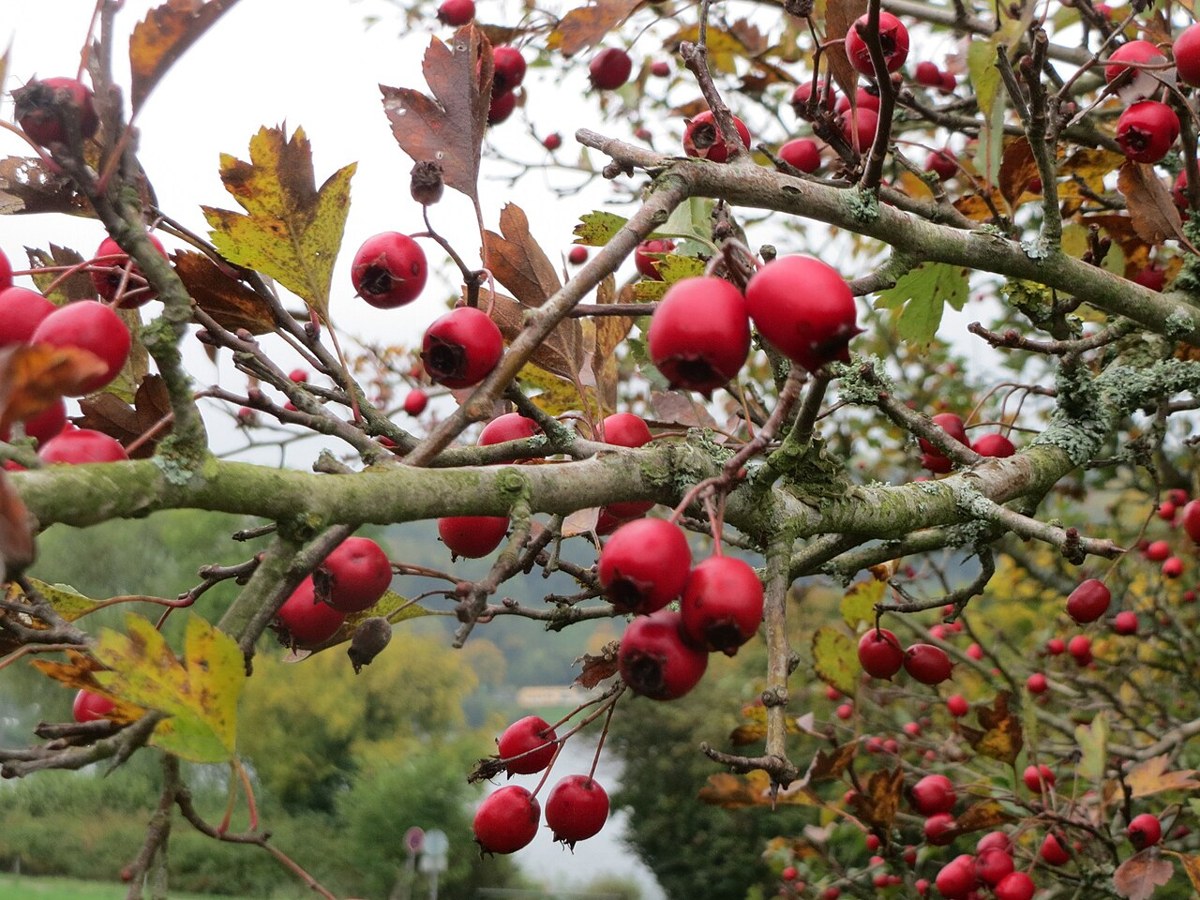
When the leaves thin out in October, small red fruits glow everywhere along field edges and in hedges. Many of them belong to hawthorn – in German folk speech they are called Mehlbeeren, "flour berries". But other shrubs carry red fruit in autumn too, and some of them should never go near your mouth: above all the yew. Here is how to recognise hawthorn and how to tell it apart from its look-alikes.
Hawthorn
Common hawthorn (Crataegus monogyna) is the most widespread hawthorn in Central Europe. It grows as a shrub or small tree, usually 2 to 6 metres tall, in hedges, thickets and at woodland edges, preferably on chalky soil. There is also Midland hawthorn (Crataegus laevigata) and many hybrids between the two.
Its German name Hagedorn comes from Middle High German hagendorn: the thorn that grows in the hedge. Hawthorn flowers white in May and June – hence its other German name, Weißdorn, "white thorn". In English it is also known as may or quickthorn.
How to recognise hawthorn
Thorns
The branches carry many strong thorns. Hawthorn hedges are dense and hard to get through – gloves help.
Leaves
- 5 to 7 centimetres long.
- Lobed: in common hawthorn they are divided about halfway into three to seven lobes, toothed at the tips.
- In autumn they turn yellow to brown and drop – hawthorn is not evergreen.
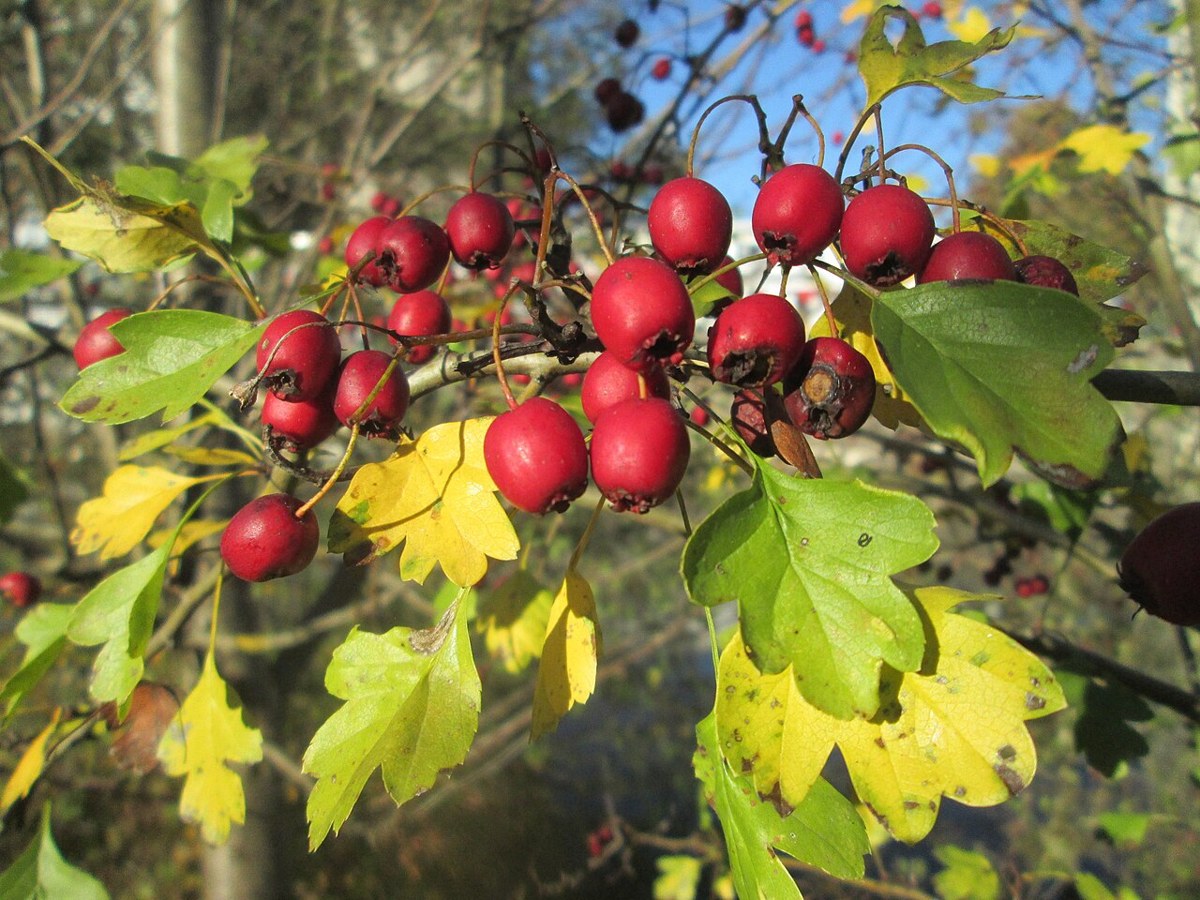
Common hawthorn in October: deeply lobed leaves, berries in clusters. Photo: AnRo0002, CC0.

Berries
- 8 to 10 millimetres long, egg-shaped, dark red.
- At the tip sits a small, dark crown of dried sepals.
- Inside is a single hard stone in common hawthorn, two to three in Midland hawthorn.
- The berries hang in clusters on long stalks and often stay on the shrub well into winter.
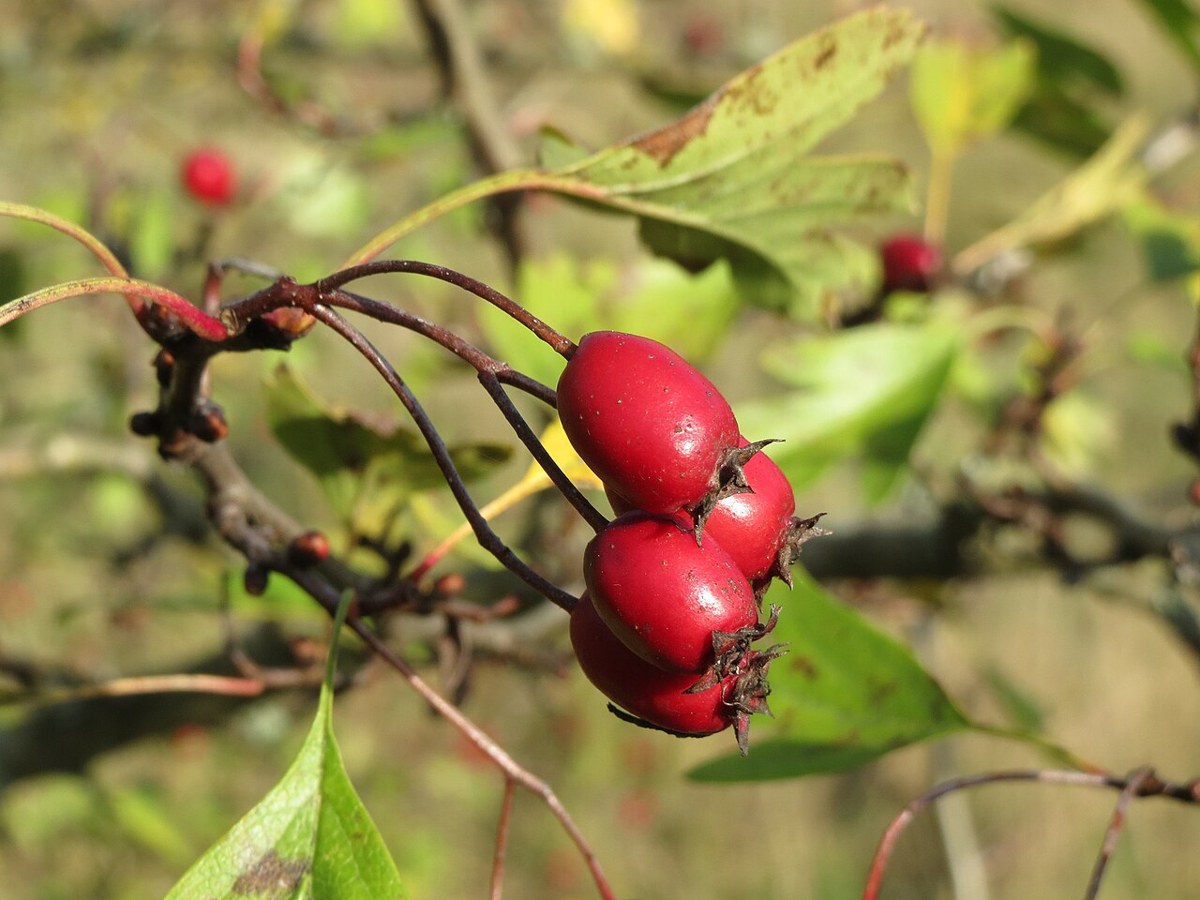
Hawthorn berries up close: the dried sepals at the tip. Photo: AnRo0002, CC0.

Midland hawthorn has less deeply divided leaves with blunt lobes and brick-red to brownish-red berries. Because the species hybridise, the exact species is often hard to pin down – but that does not matter for telling hawthorn apart from its poisonous look-alikes.
Watch out: look-alikes
Yew – poisonous to highly poisonous
Yew (Taxus baccata) is the most dangerous red look-alike. The Bonn Poison Information Centre (GIZ Bonn) rates it poisonous to highly poisonous. Needles and seeds contain high concentrations of the toxin taxine. According to the centre, possible effects include nausea, dizziness, heart and circulation problems, seizures and death.
Yews grow in woodland, but mostly they are planted – in gardens, parks and cemeteries, often as hedges.
How to tell them apart:
- Needles, not leaves: yew is an evergreen conifer. Its flat needles are glossy dark green above, paler and matt below.
- No thorns.
- The "berry" is an open cup: a scarlet, juicy seed coat, open at the top, with a dark seed sitting inside. A hawthorn berry is closed and carries the sepal remnant at its tip.
- Single, not in clusters: the red cups sit singly and spaced apart among the needles.
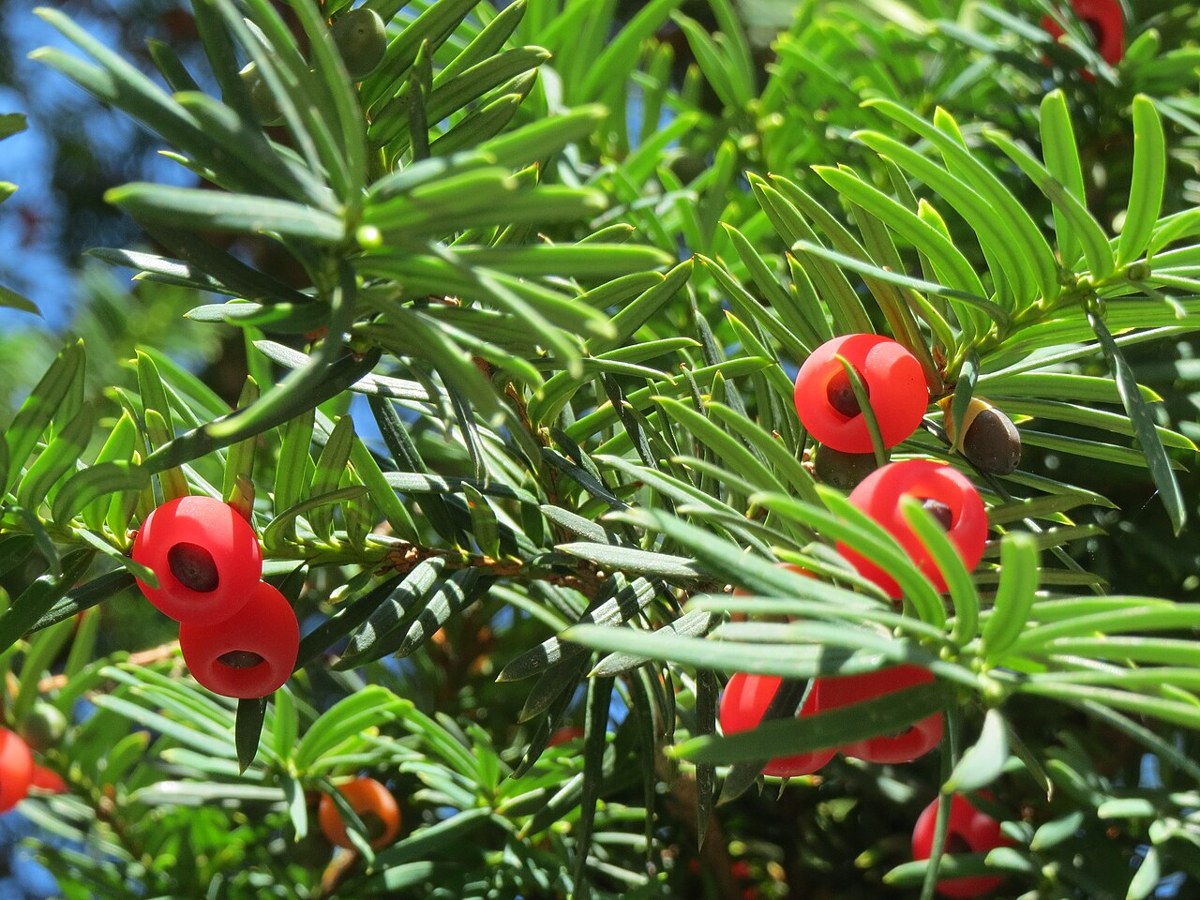
Yew: flat needles, red seed coats open at the top with a dark seed. Poisonous. Photo: AnRo0002, CC0.

In Germany, yew is also specially protected under the Federal Species Protection Ordinance. Do not pick anything from it – and show children that the red cups are off limits.
Cotoneaster – mildly poisonous
Cotoneasters are planted as ground cover and ornamental shrubs in many parks and gardens. According to GIZ Bonn, their small red fruits contain amygdalin, a glycoside that releases cyanide. Larger amounts can cause vomiting and diarrhoea. The centre rates them mildly poisonous.
How to tell them apart:
- No thorns.
- Small, undivided leaves with smooth edges – no lobes.
- Richly branched twigs, often spreading low over the ground.
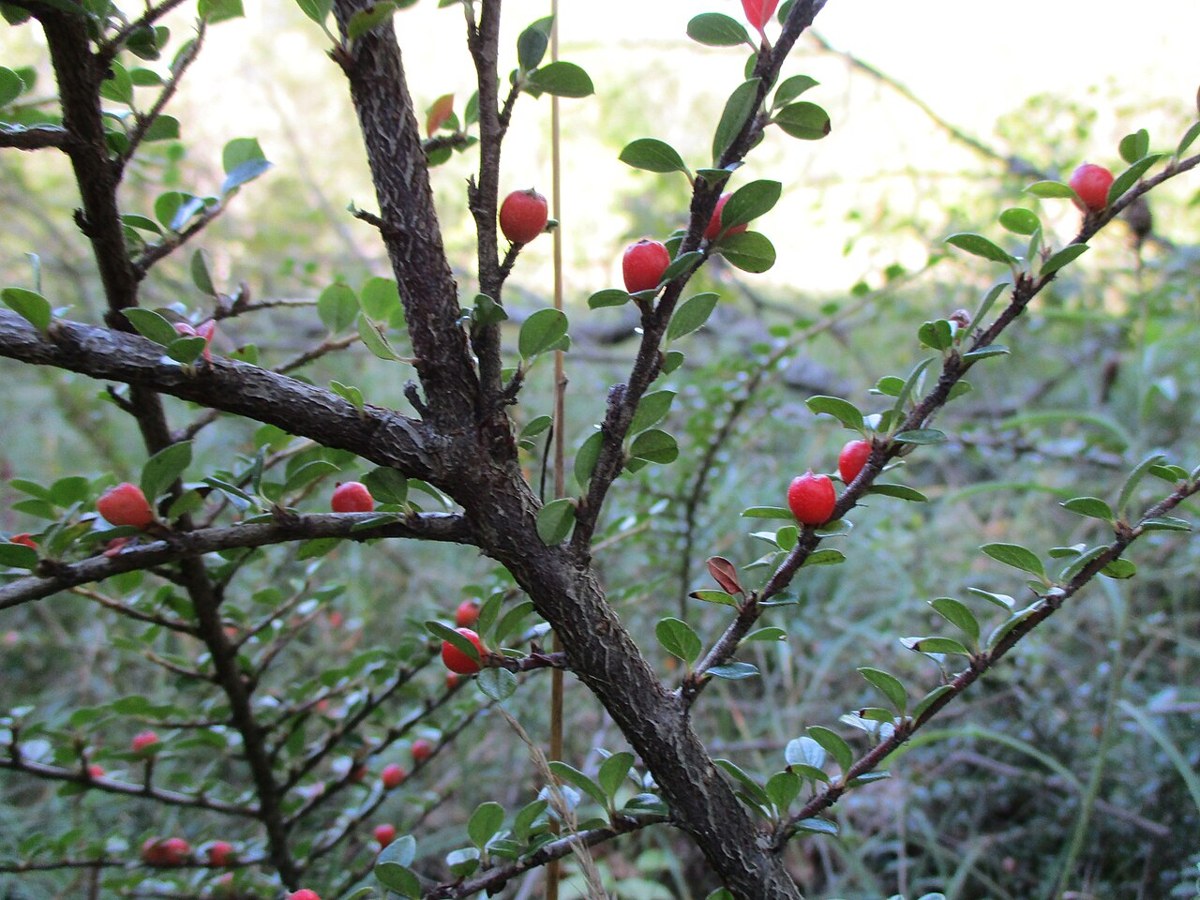
Wall cotoneaster: small, undivided leaves, no thorns. Photo: AnRo0002, CC0.

Spindle – poisonous
Spindle (Euonymus europaeus) grows exactly where hawthorn grows: at woodland edges, in hedges and along field margins. It fruits in September and October. GIZ Bonn rates all parts as poisonous, especially the seeds. Its fruits are angular, four-chambered capsules holding up to four seeds, not round berries. Look closely and you will not mix them up. Look only for "something red in the hedge" and you might.
Firethorn and holly
Firethorn (Pyracantha) has thorns like hawthorn and carries orange-red fruit in dense clusters. But it is evergreen, and its leaves are undivided and finely toothed, not lobed. GIZ Bonn rates it non-poisonous. It is mainly planted as an ornamental shrub and hedge, though it also grows wild.
Holly (Ilex aquifolium) has glossy, leathery, evergreen leaves, often with a jagged edge, and pea-sized red berries. According to GIZ Bonn, all parts are mildly poisonous.
The one rule
Hawthorn means: thorns, lobed leaves that drop in autumn, and red berries in clusters with a dark sepal remnant at the tip. If anything is missing – needles, smooth undivided leaves, open cups, angular capsules – or if you are in doubt: leave it.
Foraging rules in Germany
Hawthorn is not on the list of specially protected plants in the Federal Species Protection Ordinance. Section 39 (3) of the Federal Nature Conservation Act allows you to gather wild fruit carefully in small quantities for personal use – in places you are allowed to enter.
- Nature reserves have their own bans. Watch for signs and stay on the paths.
- Do not pick in other people's gardens, on private land or from hedges on someone else's property.
- Do not break off branches. Pick the berries one by one or strip them off.
- Leave plenty behind. Hawthorn berries stay on the shrub into winter and are an important food for thrushes and waxwings. Many birds nest in the thorny hedges; the red-backed shrike impales its prey on the thorns.
Flour berries in the kitchen – a look at history
The German name Mehlbeere hints at how the fruit was used: in hard times the dried, mealy flesh was ground into a kind of flour or cooked into a purée. Ground seeds served as a coffee substitute, the leaves as a substitute for tea or tobacco. Sometimes the berries were used to flavour schnapps.
That is cultural history, not a recipe. Hawthorn is a medicinal plant used for heart complaints (see below). If you take heart medication, talk to your doctor or pharmacist before using hawthorn.
A medicinal plant with a long tradition
Even the botanical name points to medicine: crataegus means "strong, sturdy". Flowers, leaves and berries have long been used as a medicinal plant.
The European Medicines Agency has classified hawthorn leaf and flower as a traditional herbal medicinal product. Its expert committee bases this explicitly on long-standing use, not on clinical trials – according to the EMA, such trials are largely lacking. The use is for nervous heart complaints such as palpitations, and only after a doctor has ruled out serious conditions.
That is the state of research, not a recommendation: heart complaints belong with a doctor, not in self-treatment with foraged berries.
Quick checklist
- Thorns on the twigs? → Could be hawthorn (or firethorn).
- Lobed leaves that turn yellow or drop in autumn? → Hawthorn.
- Berries in clusters, round to egg-shaped, with a dark sepal remnant at the tip? → Hawthorn.
- Needles, red cups open at the top? → Yew, poisonous. Do not touch.
- Small smooth-edged leaves, no thorns? → Cotoneaster. Angular capsules? → Spindle. Leave them.
- Only small amounts, no broken branches, plenty left for the birds – and only where you are allowed to go.
Find hawthorn near you
The Fruit Pin map shows freely accessible spots – fruit trees, nuts, berries and herbs. Set the filter to Berries and In season to see what may be ripe in your area right now.
A map entry does not replace identification on site: always check the thorns, leaves and berries yourself.
Know a hawthorn hedge in a freely accessible place? Add a spot – so others can find it too.
Another red autumn fruit in hedges is the rose hip: Foraging rose hips. For more wild fruit, see our overview Wild fruit in November.
Before you pick
Identify every plant yourself with certainty before you eat it. Entries on this map come from users and are not verified by us. When in doubt, do not consume.