Evidence, not hearsay
Nothing goes on the map without a photo. At least one, taken on site. We don’t add coordinates without evidence, and we don’t buy in bulk data.
Fruit Pin maps publicly accessible spots across German-speaking Europe. Every spot is backed by at least one photo, and every entry comes from users. You don’t need an account to look around.
Free to use. All information comes from users and is not verified by us.

Why
Nothing goes on the map without a photo. At least one, taken on site. We don’t add coordinates without evidence, and we don’t buy in bulk data.
Visit a spot someone else added and you can upload another photo or a short video. That’s how you can see when someone was last there — not just that somebody added it at some point.
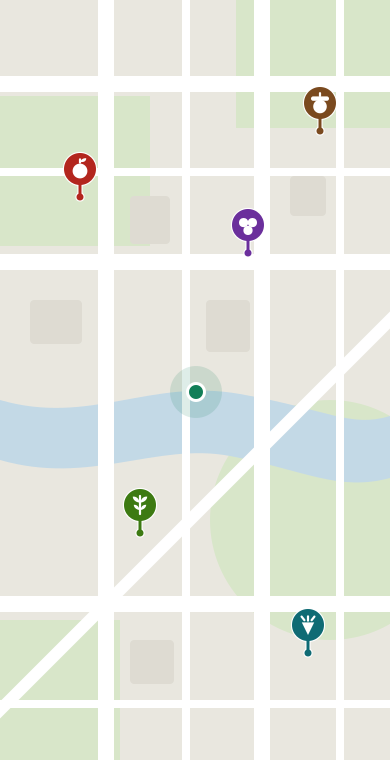
Filter by category and by what’s in season right now. Right on the map, not in a PDF you have to download first.
Designed for one hand, one phone and bright daylight: large targets, strong contrast, short paths. The map gets the space; everything else only covers it briefly.
How it works
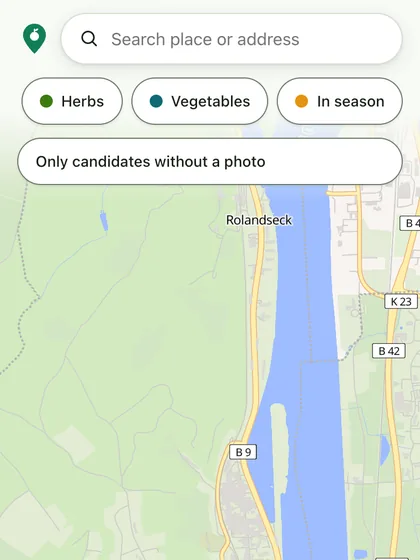
Search for a place or use your location. Filter by fruit, nuts, berries, herbs or wild greens — and by what’s in season right now.
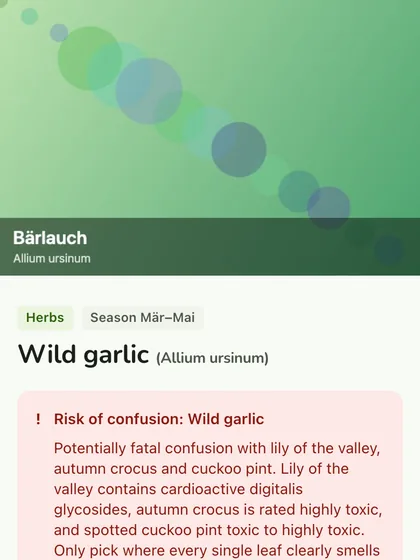
You’ll see every photo and video users have uploaded for that place, plus the species, the season, how to get there and the safety note for that species. And you’ll see when someone was last there.
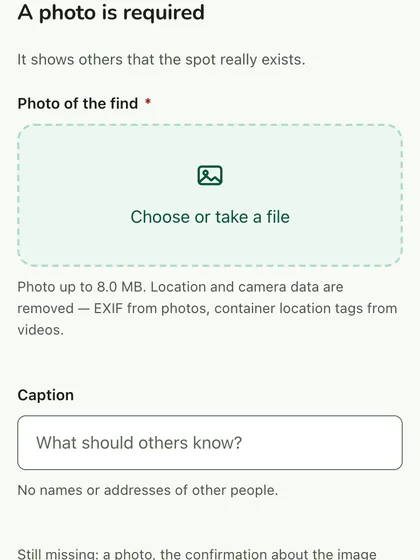
Been there yourself? Upload a photo — either as a new spot or as another piece of evidence for an existing one. That needs an account — an email and a password are enough, and we suggest a name for you. We never ask for your real name.
Trust
This map provides locations. It is not an identification aid and not a recommendation to consume anything. Here is what we do about that.
Identify every plant yourself with certainty before you eat it. Information on this map comes from users and is not verified by us. When in doubt, do not consume it.

No photo, no entry. Several users can confirm the same place with their own photos and short videos. For every contribution you can see who uploaded it and when.
For every species with a risk of confusion we show the matching note — on the spot, in a fixed position, not collapsible. Anyone adding a spot for such a species sees the note again before saving.
Take part
The first contribution puts a place on the map. The second shows it’s still there. The third shows what it looks like a year later. That’s why “I was here too” isn’t a thumbs-up here — it’s your own photo, with a date on it.


We plan to add a small shop with gear for collecting. It doesn’t exist yet, and we’re not naming a date. So you know where we stand: that’s how we intend to fund the project. The map is free to use, and we don’t sell user data.
FAQ
Nothing. The map, spots, photos and profiles are open to everyone, with or without an account.
Not to browse. Yes, to add spots or upload media — an email address and a password are enough. Prefer no password? We can email you a sign-in link instead.
No. We provide locations, not identification help and not a recommendation to consume anything. For species with a risk of confusion we show a note, but identifying the plant remains your job. When in doubt, do not consume it.
Every spot has at least one photo, and every contribution shows its author and date. The more people have confirmed a place, and the more recent the last contribution, the better your basis. None of it is verified by us.
In Germany, wild-growing fruit and tea and medicinal herbs are covered by the “Handstrauß” rule: in places without an access ban, in small quantities, for personal use and without damaging the plant. Commercial collecting needs authorisation, and stricter rules apply in protected areas. None of this applies on someone else’s private land. Outside Germany, different law applies.
Report it using the report button on the spot. No account needed. The spot is hidden until we’ve looked at it.
