Are Mahonia berries poisonous? Tell them from privet
Blue berries on an evergreen shrub: what Mahonia is, how to tell it from privet with its poisonous black berries, and what the foraging rules say.
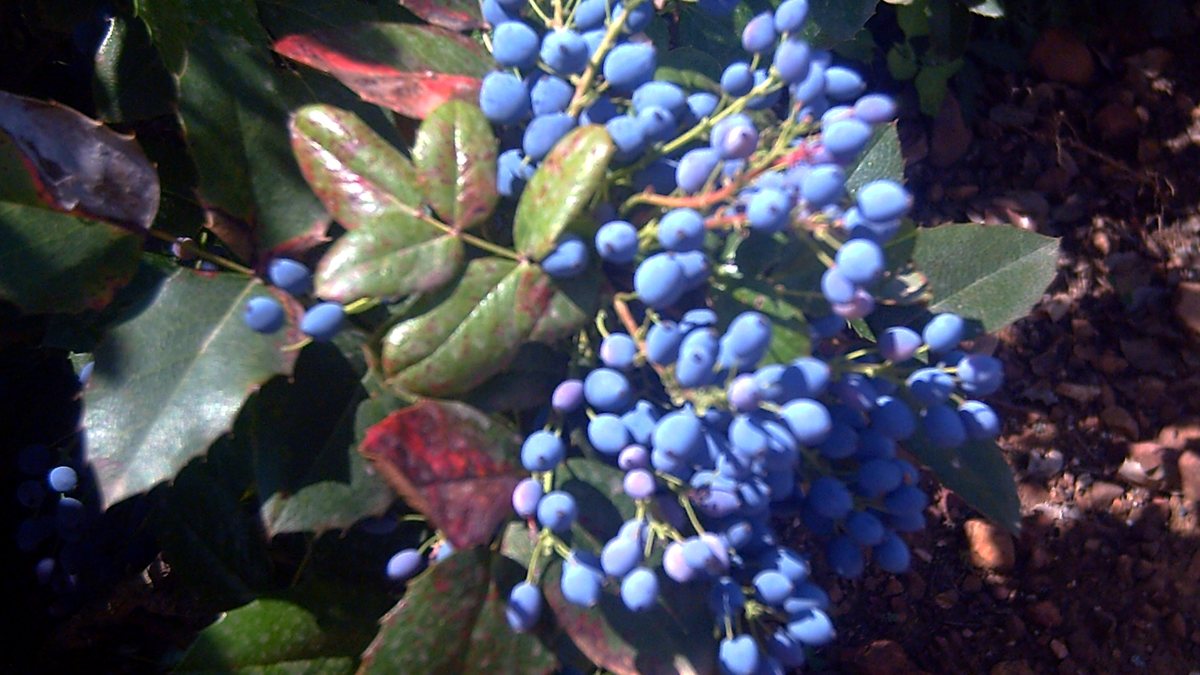
Dark blue berries on an evergreen shrub, in a housing estate or a park: that is usually Mahonia. The fruits look like small grapes. A shrub that looks similar has poisonous berries, though: privet.
What Mahonia is
Oregon grape (Mahonia aquifolium, German: Gewöhnliche Mahonie) belongs to the barberry family, like barberry itself. It comes from western North America and is a neophyte in Europe, meaning an introduced species. In Germany it grows mostly as an ornamental shrub in parks, gardens and green spaces. That is why you find it more often next to apartment blocks and car parks than in the forest.
The key points:
- Evergreen shrub, up to more than 2.5 metres tall, often with several stems.
- Leaves pinnate, up to 30 centimetres long, with up to nine leaflets. Each leaflet is glossy dark green on top with 10 to 20 spiny teeth along the edge. In winter the leaves sometimes turn bronze-red to purple.
- Flowers from March to June: dense, yellow, fragrant clusters.
- Berries from August: up to 1.2 centimetres, blue-black with a bluish bloom when ripe, containing two to five reddish-brown seeds.
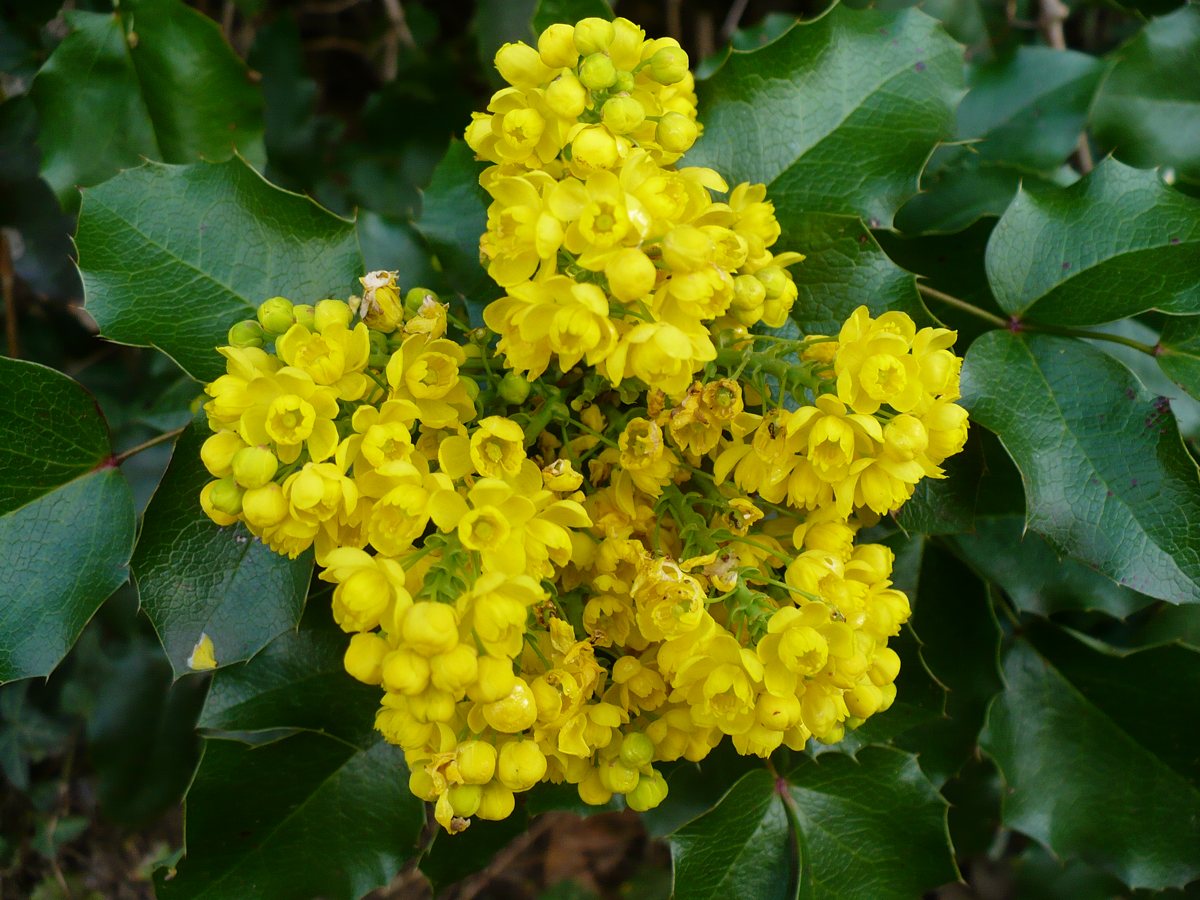
Mahonia in April: a yellow flower cluster among glossy leaves with spiny teeth. Photo: Syp, public domain.

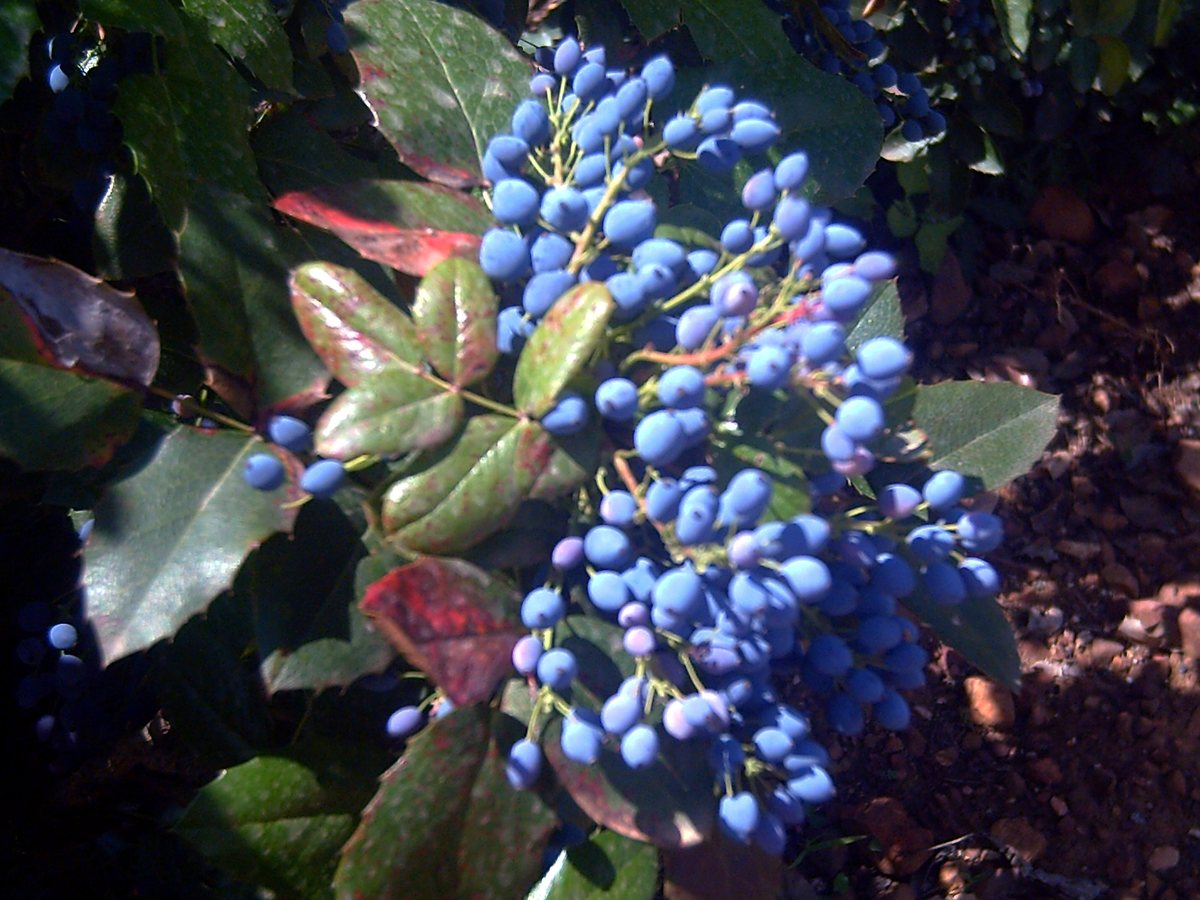
Ripe Mahonia berries: blue, with a pale bloom. Photo: Javier martin, public domain.

Because of its toothed leaves, Mahonia is sometimes mistaken for holly, and laypeople often take it for laurel. Holly carries red fruits, not blue ones.
Watch out for look-alikes: privet
Common privet (Ligustrum vulgare, German: Gewöhnlicher Liguster) is common in hedges, gardens and along paths. In autumn it carries glossy black berries, and those are poisonous: according to the specialist literature they can cause nausea, vomiting, diarrhoea and abdominal pain. The leaves also contain the glycoside syringin. Skin contact while cutting the plant can cause irritation, known as privet eczema.
How to tell the two apart:
- Leaf: Mahonia has a pinnate leaf with several leaflets and spiny teeth along the edge. Privet has a simple, smooth-edged leaf, 2.5 to 8 centimetres long.
- Leaf arrangement: Mahonia alternate, privet opposite (two leaves sit directly facing each other).
- Berry: Mahonia blue-black with a bluish bloom, privet glossy black.
- Flower: Mahonia yellow, March to June; privet white to cream, May to July.
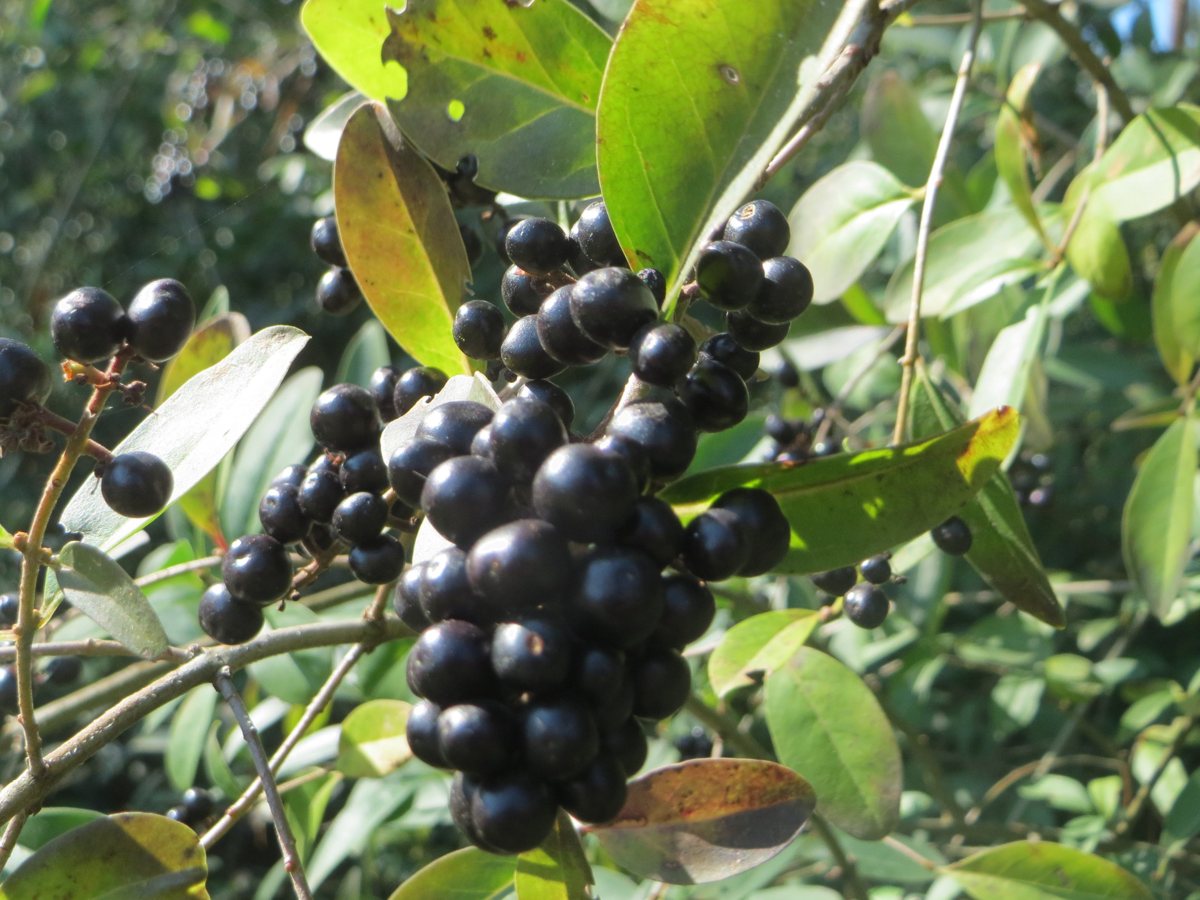
Privet in September: glossy black berries, leaves without teeth. Poisonous. Photo: AnRo0002, CC0.

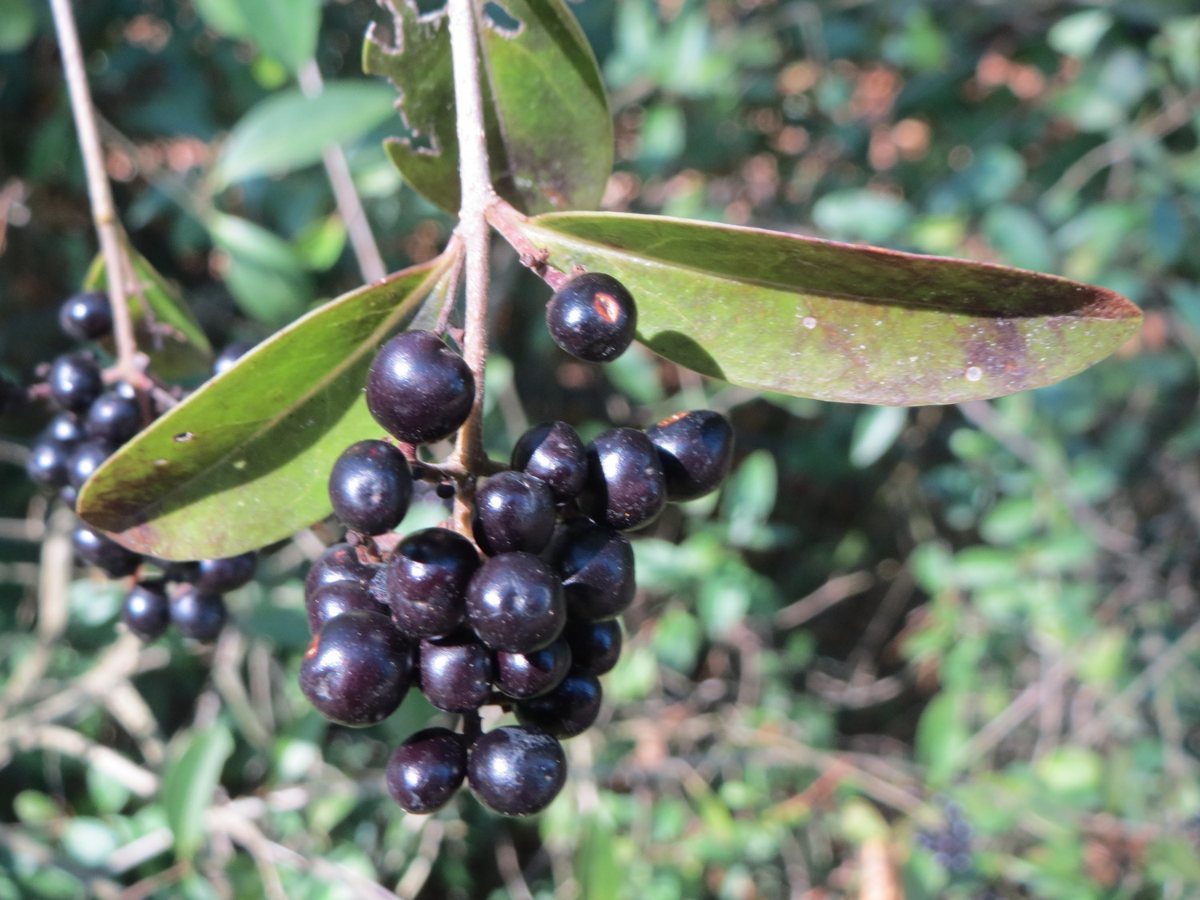
Privet: simple, smooth-edged leaves with black berries. Poisonous. Photo: AnRo0002, CC0.

The one rule
Look at the leaf first, not the berry. The leaf separates the two shrubs even when the berries have already fallen: a pinnate leaf with spiny teeth belongs to Mahonia. A simple, smooth-edged, opposite leaf does not belong to Mahonia. Then leave the berries hanging. If you are not completely sure what is growing in front of you, leave it.
Red or black berries on other shrubs in the hedge are another trap. For barberry, a close relative of Mahonia, read Barberry – poisonous or not?. For red autumn fruits see Hawthorn berries.
What people do with Mahonia berries
The ripe berries taste very sour and have a dark red juice. According to the literature they are made into jam and fruit wine, and mixed with low-acid fruit they serve as a colouring. They contain vitamin C and minerals; the alkaloid content of the berries is about 0.05 percent.
Important: only the ripe berries are used. The roots contain up to 1.5 percent berberine and other alkaloids, and most parts of the plant count as poisonous. Leaves, bark and roots do not belong in the pot.
The plant also dyes: wool, silk and cotton can be dyed blue-violet with the berries.
Mahonia in folk medicine
The literature mentions extracts of bark and root that were traditionally used for skin conditions such as psoriasis. That is cultural history, not a recommendation: we give no use and no dose, and home-made extracts of the plant are not a household remedy.
Where you may gather
- Planted shrubs in gardens, housing estates and parks belong to someone. The German Federal Nature Conservation Act allows, in § 39 paragraph 3, gathering wild-growing fruit in small quantities for personal use. A planted ornamental shrub is different: ask the owner or the property management.
- Naturalised Mahonia at forest edges or on waste ground falls under the rule for wild-growing plants, as long as you may enter the land.
- Protected areas: in some nature reserves Mahonia is even controlled as an introduced species. The rules of the area apply there. Watch for signs.
Quick checklist
- Evergreen shrub with pinnate leaves and spiny teeth? → points to Mahonia.
- Berries blue-black with a pale bloom? → matches.
- Simple, smooth-edged, opposite leaves and glossy black berries? → privet, poisonous.
- Only take berries when leaf and berry match.
- Do not use roots, bark or leaves.
- Only where you may: planted shrubs only with permission.
If someone has eaten privet berries and feels unwell, call the poison information centre of your federal state or the emergency number 112.
Find Mahonia near you
The Fruit Pin map shows freely accessible finds – fruit trees, nuts, berries and herbs. Set the filter to Berries and In season to see what is growing near you right now.
A pin on the map does not replace identifying the plant on the spot: always look at the leaf and the berry yourself.
Know a Mahonia at a freely accessible spot? Add it with Add a spot so others can find it too.
Before you pick
Identify every plant yourself with certainty before you eat it. Entries on this map come from users and are not verified by us. When in doubt, do not consume.