Are barberries poisonous? How to identify barberry
Barberry's red berries hang on into winter. Which parts are poisonous, how to recognise the shrub and how to tell it from bittersweet nightshade.
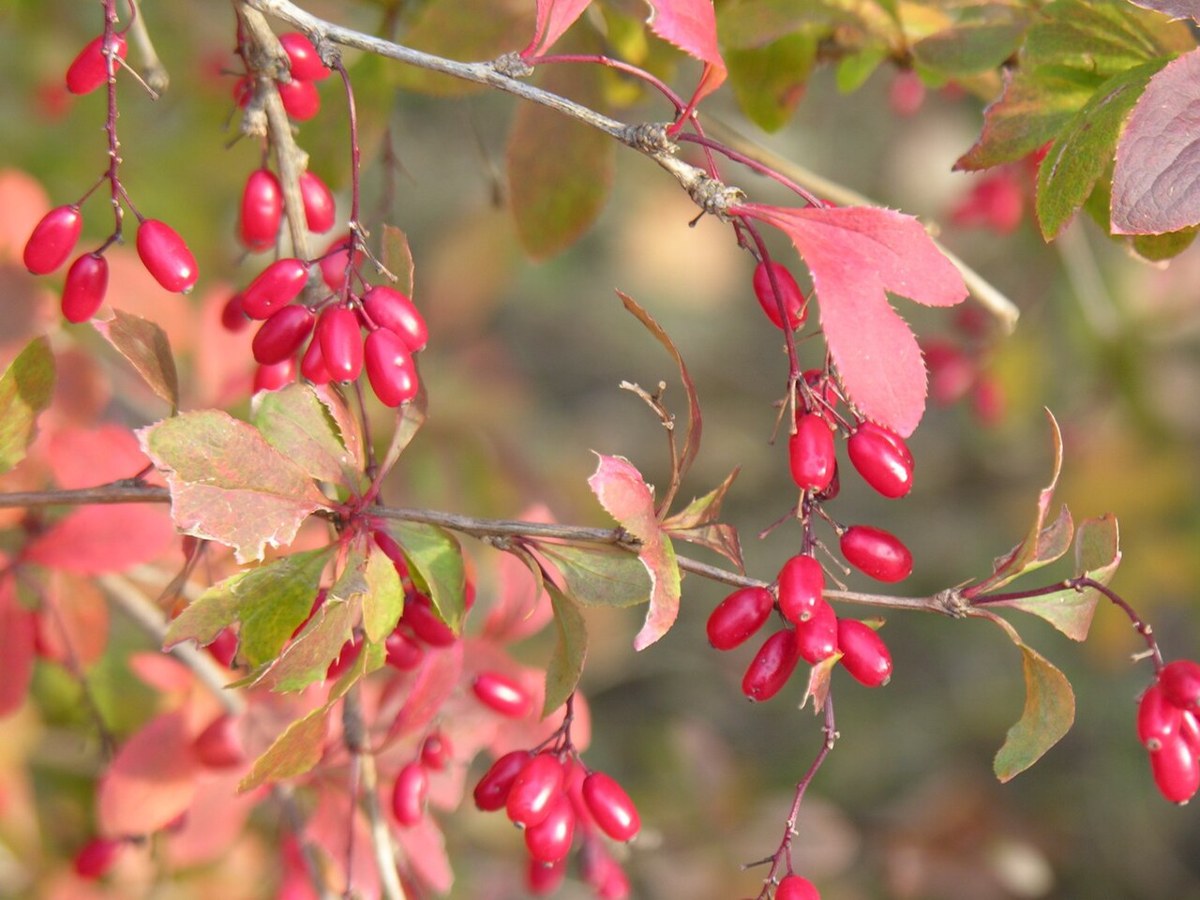
In late October, small, elongated, scarlet berries in hanging clusters light up woodland edges and thickets. Many of them belong to common barberry (Berberis vulgaris), known in German as Sauerdorn ("sour thorn") or Essigbeere ("vinegar berry"). Is it poisonous? The short answer: the plant is, the ripe berries usually are not. Here is how to recognise barberry, which poisonous plant carries very similar berries – and why the shrub was once wiped out in many places.
What is poisonous about barberry
The Bonn poison information centre (GIZ Bonn) rates common barberry as slightly poisonous. The toxins sit mainly in the root bark, followed by the stem bark: isoquinoline alkaloids, chiefly berberine. Flowers, fruit flesh and seeds are usually free of alkaloids.
Larger amounts of the poisonous parts can cause nausea, vomiting and diarrhoea. That gives you one clear rule: only gather the ripe red berries – never bark, root or twigs.
How to identify barberry
In common barberry, these features go together:
- Habit: a deciduous shrub, usually 1 to 3 metres tall, with long, whip-like shoots.
- Spines: sharp spines along the shoots, often three-parted or more at the base of a shoot. They are modified leaves.
- Leaves: obovate to elliptic, a few centimetres long, with finely spiny-toothed margins. They grow in clusters in the axils of the spines.
- Bark: yellowish brown to grey outside, bright yellow inside.
- Berries: oblong-ovoid, smooth and glossy, scarlet, up to about 1 centimetre long, with a small dark remnant of the stigma at the tip. They hang in clusters and usually hold one or two narrow seeds.
- Flowers: yellow, hanging flower clusters in May and June.
The berries turn red from August. Many stay on the shrub well into winter – which is why you can still find them now, in late autumn.
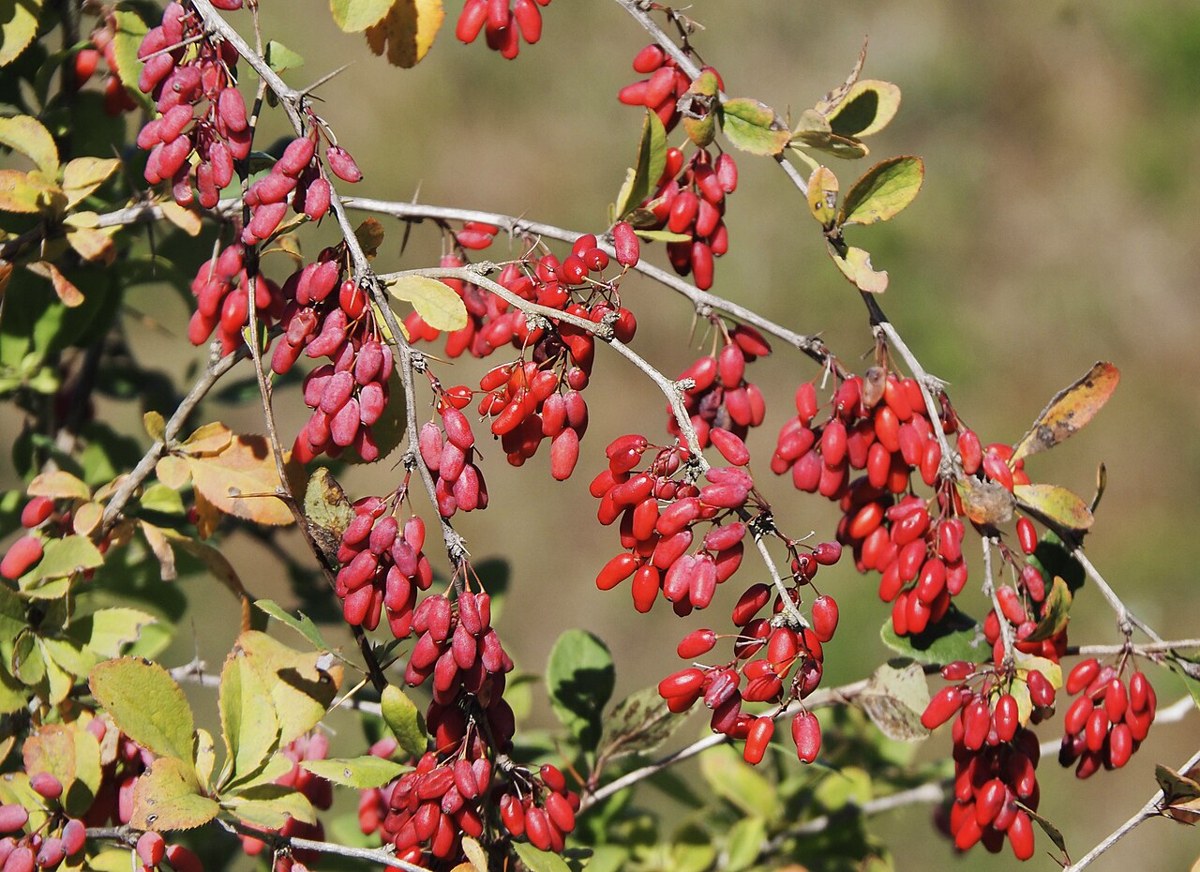
Common barberry: thin spines on the shoot, leaf clusters and dense clusters of elongated berries. Photo: Arkelin, CC BY 4.0, resized.

Watch out for garden varieties: hedges and front gardens hold many other barberry species and cultivars, often with red or dark red leaves. This article only covers common barberry. If you cannot identify the species: leave it.
Lookalike warning: bittersweet nightshade
The most dangerous lookalike carries almost identical berries: elongated, scarlet, glossy, in hanging bunches – and ripe at exactly the same time, from August to October.
According to GIZ Bonn, bittersweet nightshade (Solanum dulcamara) is slightly poisonous to poisonous. All parts of the plant contain nightshade alkaloids such as solanine. Possible effects include vomiting and diarrhoea, headache, dilated pupils and a racing pulse.
How to tell it apart:
- No spines. Nightshade is a climbing or sprawling semi-shrub with flexible stems that turn woody only at the base. It likes to climb through other shrubs – so its berries sometimes hang right in the middle of a hedge.
- Leaves: single, stalked, oval-oblong and smooth-edged; the upper ones sometimes have one or two small side lobes ("ears"). No clusters, no toothed margin.
- Berry: many-seeded, with a small, star-shaped calyx where it meets the stalk.
- Flowers: purple, five-lobed, the lobes finally bent back, from June to August. Green and red berries often hang on the same plant at once.
- Habitat: usually damp – riverbanks, floodplain woods, willow scrub, path edges.
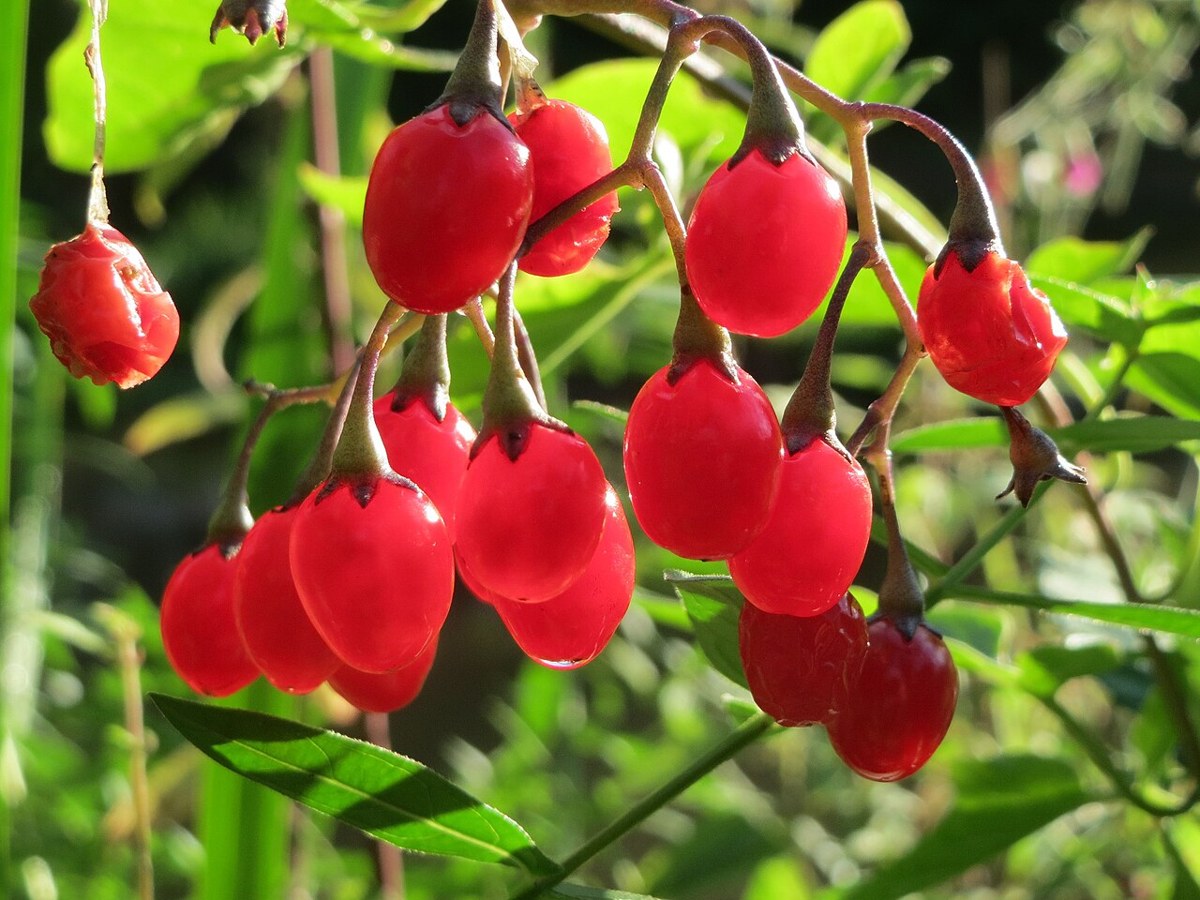
Bittersweet nightshade: similar red berries, but with a calyx at the stalk and no spines on the stem. Photo: AnRo0002, CC0.

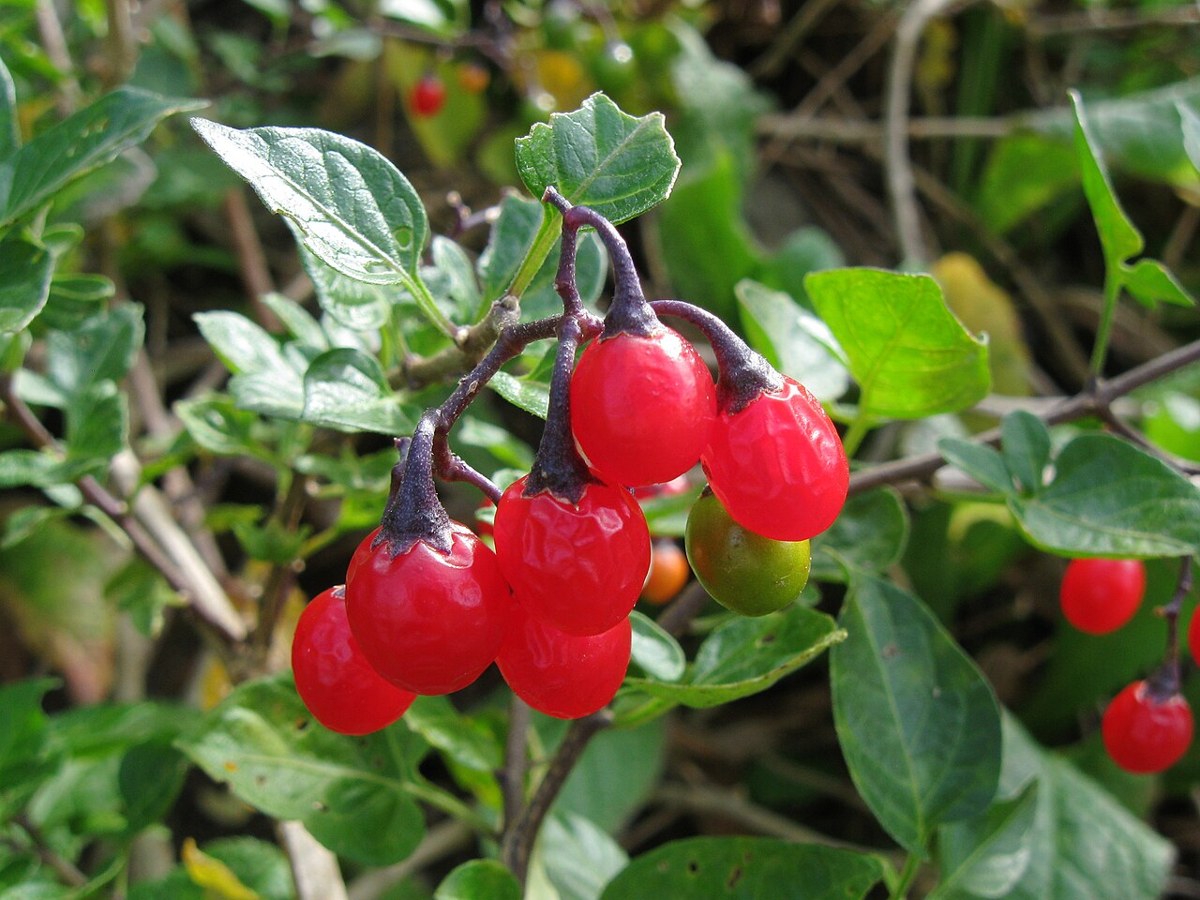
Bittersweet nightshade: single, smooth-edged leaves instead of toothed leaf clusters. Photo: Cbaile19, CC0.

Other red berries in the hedge
- Fly honeysuckle (Lonicera xylosteum): its scarlet berries sit in pairs, often partly fused. Opposite, broadly elliptic leaves, no spines. GIZ Bonn rates the berries as slightly poisonous to poisonous.
- Yew (Taxus baccata): needles instead of leaves, a red cup open at the top around a dark seed. Yew is poisonous to highly poisonous – more in Hawthorn berries.
The one rule
Spines, leaf clusters with finely toothed margins, yellow inner bark and elongated berries with one or two seeds in hanging clusters: only gather when everything matches common barberry. If any feature does not fit – leave it.
What barberries taste like and how they are used
Raw, the berries are very sour – they contain a lot of malic acid and other fruit acids. That is where the old German names "sour thorn" and "vinegar berry" come from.
In Europe they are traditionally made into jam. Dried, they are used like raisins, for example in muesli. In Iran, dried barberries are a well-known ingredient: they give rice dishes a sweet-and-sour note – such as the barberry rice zereshk polo – and are also used with fish and roasts. In the Caucasus the berries are fermented as well.
Practical tips for gathering:
- Gloves protect you from the spines.
- Cut whole clusters and pick the berries off at home – it is quicker than at the shrub.
- Only take firm, red berries, no shrivelled or mouldy ones.
- For a purée or jelly, press the cooked berries through a sieve to remove the seeds.
Why barberry was nearly wiped out
Barberry has an eventful history. It is the alternate host of black stem rust (Puccinia graminis), a fungus that attacks wheat and other cereals. In summer it shows up as orange-yellow to rust-brown pustules on the underside of the leaves.
The link was already suspected in the 18th century. In France it sparked a fierce dispute between farmers and jam makers, who accused the farmers of superstition. The botanist Heinrich Anton de Bary confirmed the host change scientifically in 1866. Because it passes on the rust, barberry was nearly eradicated in parts of Europe.
It also had its place in pharmacies: the Prussian Pharmacopoeia listed barberries and a syrup made from them from 1799 to 1829. In 1830, Johann Andreas Buchner and Johann Eduard Herberger isolated the substance named after the plant from its root bark: berberine. Bark and root were also used to dye textiles, leather and wood yellow – one old German name is "Gelbaum", yellow tree.
This is cultural history, not a recommendation: in 1989, Commission E of Germany's former Federal Health Office issued a negative assessment of barberry fruit, bark and root. Berberine is being researched as a possible active substance today – that is a state of research, not a reason to use bark or root.
Where barberry grows – and the rules for gathering
Common barberry likes lime and warmth. You will find it on woodland edges, in open woods, thickets and open floodplain forest, often on dry to moderately moist soils. It is also planted in parks and hedges.
- Wild shrubs: in Germany, Section 39(3) of the Federal Nature Conservation Act allows you to gather wild fruit in small quantities for personal use, with care – in places you are allowed to enter.
- Protected areas: if the shrub stands in a nature reserve, special bans may apply there. Look out for signs.
- Planted hedges belong to someone. Ask first.
- Leave some behind: the berries are winter food for birds, which spread the seeds.
There are many red berries in autumn. How to recognise rowan is explained in Are rowan berries poisonous?
Quick checklist
- A shrub with spines, leaf clusters and finely spiny-toothed leaves? → points to barberry.
- Elongated scarlet berries in hanging clusters, one or two seeds? → matches.
- No spines, climbing stems, smooth-edged single leaves, a calyx at the berry stalk, many seeds? → bittersweet nightshade, poisonous.
- Berries fused in pairs? → fly honeysuckle. Needles and a red cup? → yew.
- Only the ripe berries – never bark, root or twigs.
- Only where you may: wild plants in small quantities, and respect signs in protected areas.
Find barberries near you
The Fruit Pin map shows freely accessible finds – fruit trees, nuts, berries and herbs. Set the filter to Berries and In season to see what may be ripe near you right now.
A pin on the map does not replace identifying the plant on the spot: always look at the spines, leaves and berries yourself.
Know a barberry in a freely accessible place? Add it with Add Pin so others can find it too.
Before you pick
Identify every plant yourself with certainty before you eat it. Entries on this map come from users and are not verified by us. When in doubt, do not consume.