Are rowan berries poisonous? How to identify rowan
In October rowan trees glow red. What is really poisonous about rowan berries, why cooking matters and which red fruits you must never mix them up with.
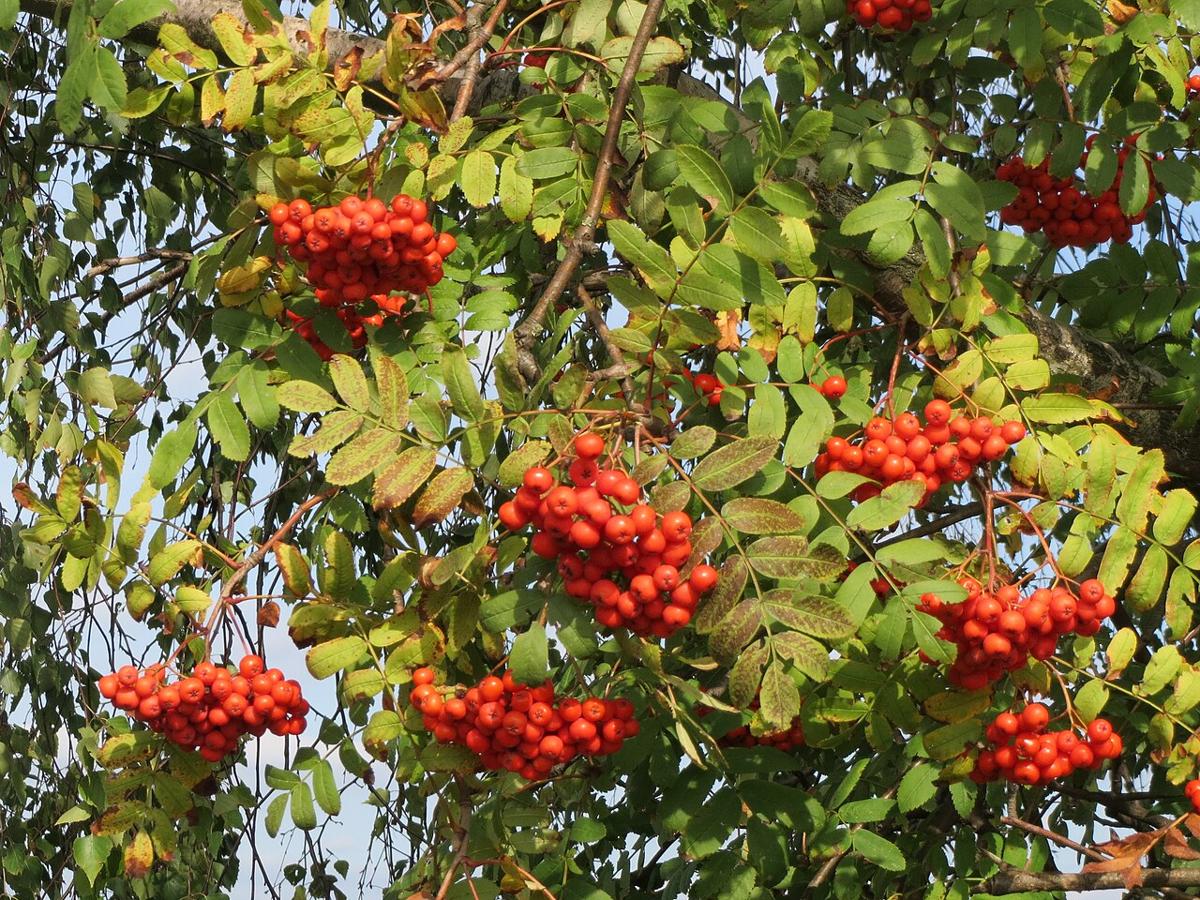
Few trees glow in October like the rowan (Sorbus aucuparia), also called mountain ash. Along streets, in parks and at the edge of woods its orange-red fruit hangs in dense clusters. Many people learn as children that rowan berries are poisonous. That is not quite right. Here is what the poison information centre says about them, why cooked rowan berries are a different thing from raw ones – and which red fruits you must never mix them up with.
Rowan, mountain ash – one tree, many names
In German the tree is called Eberesche or Vogelbeerbaum, and its fruits Vogelbeeren – "bird berries". Despite the name "mountain ash", it is not related to the ash tree; it only shares the similar pinnate leaves. Rowan is a member of the rose family and counts as a pome fruit, like apple and pear – botanically, its fruits are tiny apples.
The scientific name aucuparia comes from the Latin for bird-catching: the red fruits were once used as bait. In 1997 the rowan was Germany's Tree of the Year.
Are rowan berries poisonous?
The poison information centre in Bonn (Germany) rates rowan as mildly poisonous – and only the fresh fruit. According to the centre, only larger amounts are expected to cause mild symptoms: diarrhoea, and possibly nausea and vomiting.
The main cause is parasorbic acid. It makes raw rowan berries bitter and irritates the mucous membranes. The Bavarian State Institute of Forestry (LWF) describes that cooking destroys this substance and drying largely breaks it down. That is why rowan berries have always been used cooked – not eaten raw from the tree.
If a child has eaten a handful of raw rowan berries and you are in doubt, call the poison control line (Giftnotruf) for your federal state.
How to identify rowan
Always identify the whole tree – leaf, cluster and fruit.
The leaf
The leaf is pinnate with a single leaflet at the tip: narrow, sharply serrated leaflets sit in pairs along a reddish stalk, with one terminal leaflet at the end. The poison centre gives 9 to 15 leaflets; the whole leaf grows up to 20 centimetres long. On the twig the leaves are alternate, i.e. staggered. In autumn they turn red.
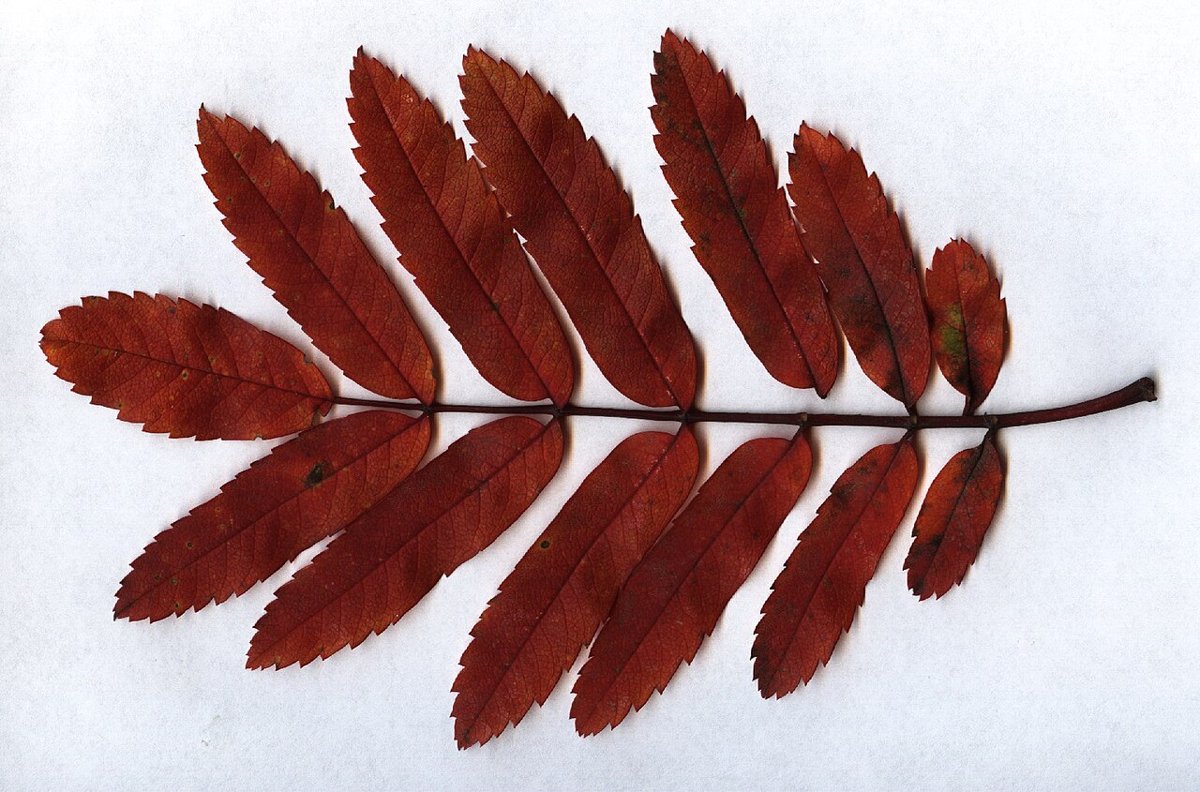
Rowan: one leaf made of many narrow, serrated leaflets, here in autumn colour. Photo: Borealis55, public domain.

Cluster and fruit
The fruits hang in broad, rather flat clusters of many single fruits. Each rowan berry is round, scarlet to orange-red and just under a centimetre across. At its tip sits a small, dark star – the remains of the calyx, just like on an apple. Inside there are usually three elongated, reddish seeds.
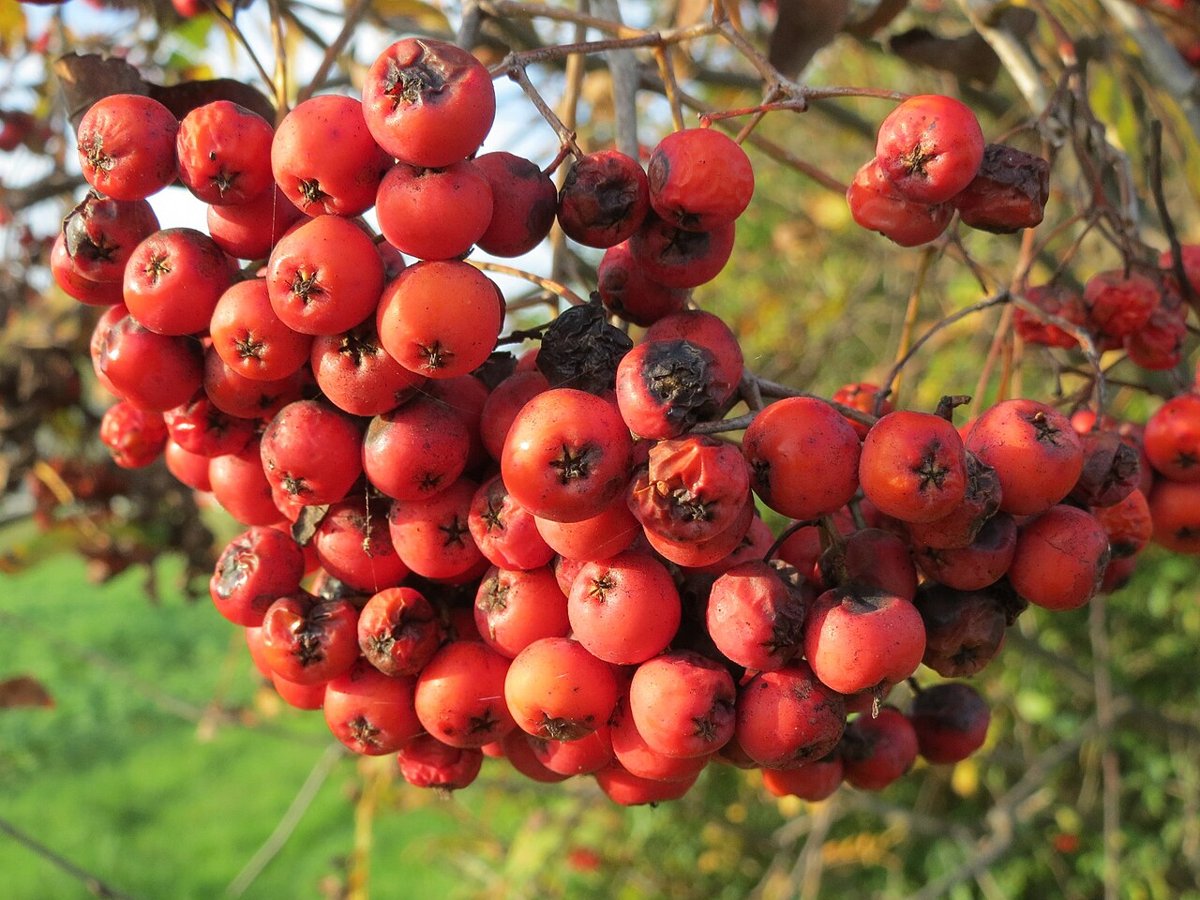
Rowan berries in October: each fruit has a dark star of calyx remains on top. Photo: AnRo0002, CC0.

Rowan is a medium-sized tree, rarely over 15 metres tall, with a loose crown and smooth, light grey bark. The fruit ripens from August to October and often hangs on into winter.
Watch out: red fruits that do not belong in the pot
Many woody plants carry red fruit in autumn. You should know three of them.
Yew – poisonous to very poisonous
The yew (Taxus baccata) grows in almost every park, in cemeteries and as a hedge. The poison information centre in Bonn rates it as poisonous to very poisonous. Its needles and seeds contain high concentrations of taxine. Poisoning can damage the heart and circulation and can be fatal.
How to tell it apart:
- Needles instead of leaves: yew is an evergreen conifer with flat needles, dark green on top.
- Single fruits instead of clusters: the red, cup-shaped seed coat sits singly on the twig and is open at the top – with a dark seed inside.
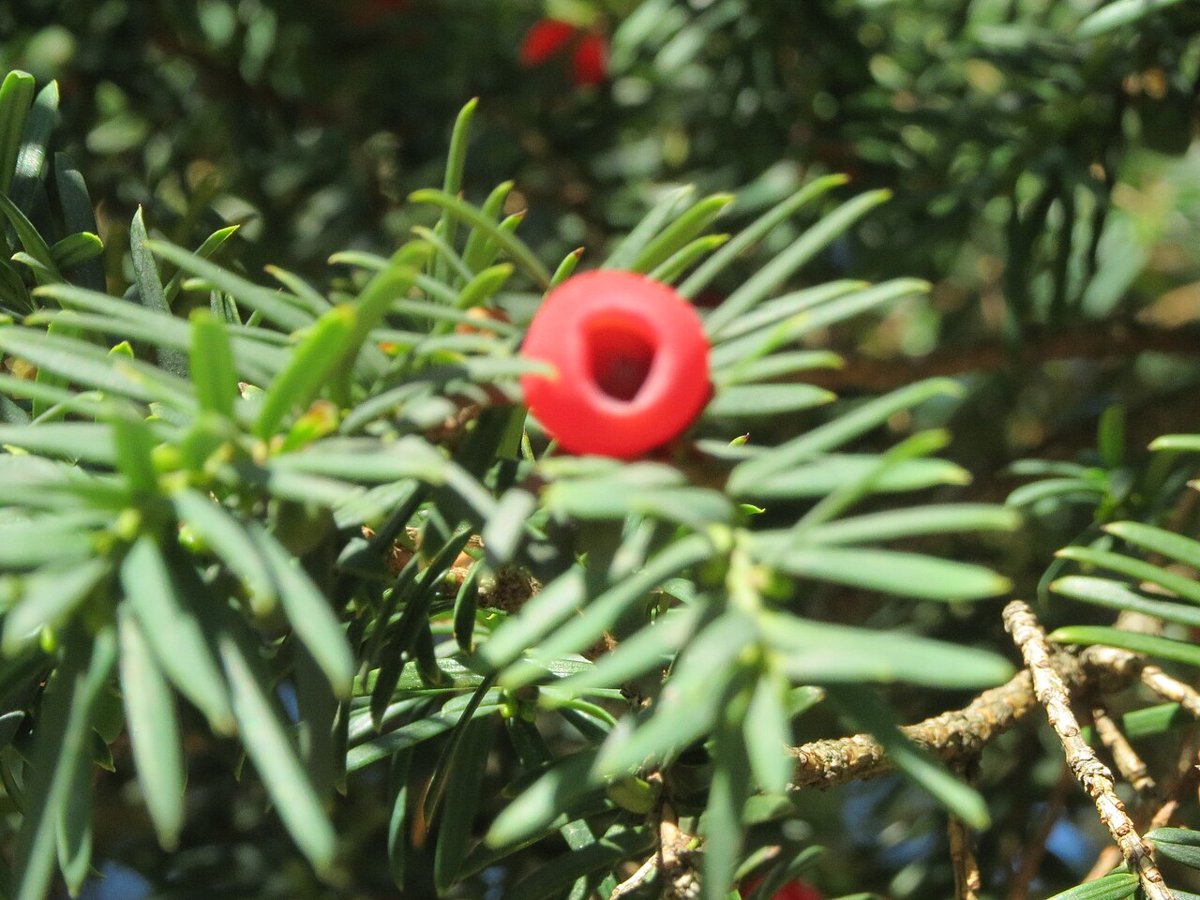
Yew: needles and a single red seed coat, open at the top. Photo: AnRo0002, CC0.

Do not pick anything from a yew.
Red elder (red-berried elder)
Red elder (Sambucus racemosa) is the most common mix-up, because it also has pinnate leaves and bright red fruit in clusters. The poison centre rates it as mildly poisonous: its seeds cause stomach and bowel upsets with nausea, retching and diarrhoea.
How to tell it apart:
- Growth: a shrub, usually only a few metres tall.
- Leaves: opposite – two leaves sit exactly across from each other on the twig. Each leaf has only 5 to 7 leaflets, which smell unpleasant when crushed.
- Cluster: densely packed, cone- to egg-shaped bunches that stand upright – not broad, flat clusters.
- Ripening time: the fruit is already ripe in high summer, in July and August.
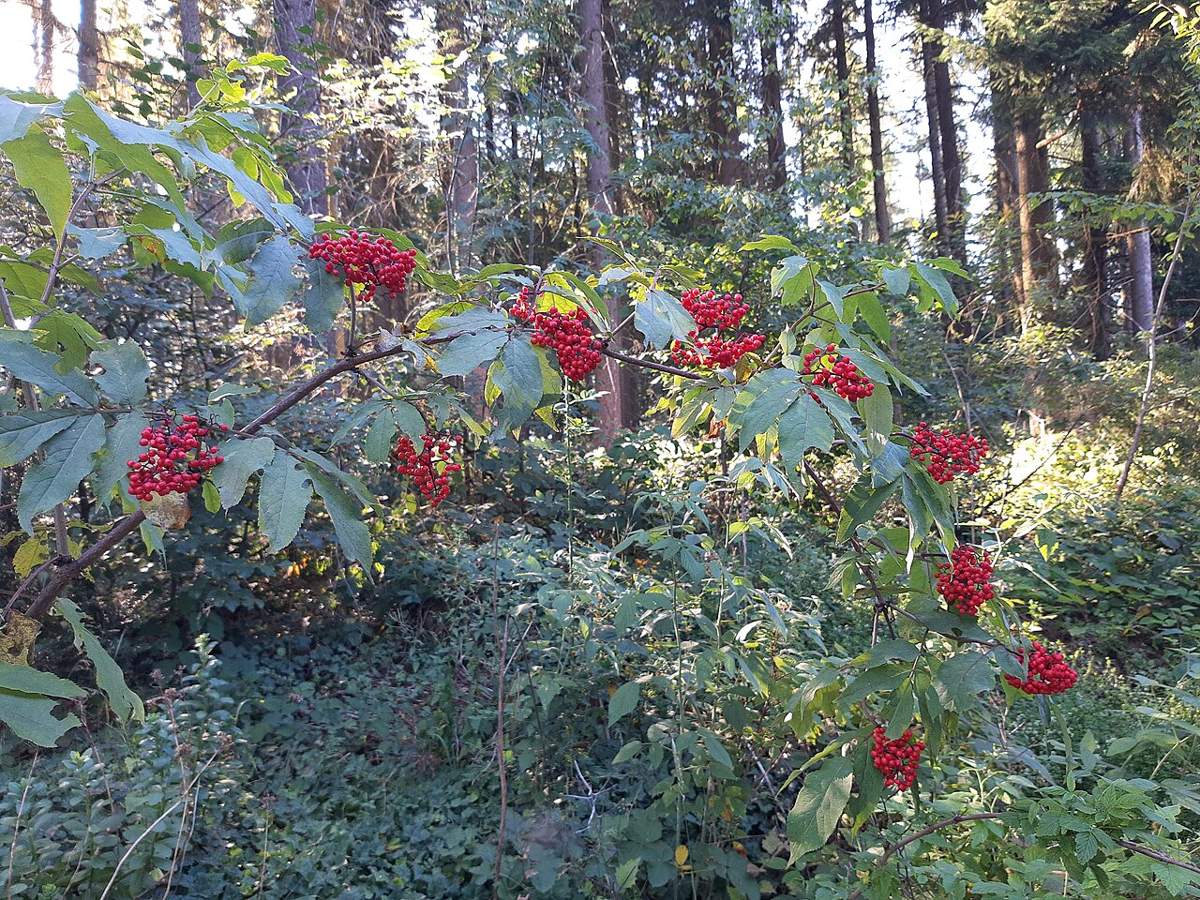
Red elder: a shrub with broad leaflets and dense, egg-shaped bunches of fruit. Photo: Gerda Arendt, CC0.

Cotoneaster
Cotoneasters grow as ground cover and ornamental shrubs in parks and gardens. They carry small red fruits but have undivided leaves with smooth edges – nothing pinnate. The poison centre rates them as mildly poisonous; larger amounts of the fruit cause vomiting and diarrhoea.
The one rule
Pinnate leaf with many narrow leaflets, alternate on the twig, flat clusters, a calyx star on every fruit: everything has to match. If you see needles, opposite leaves or dense bunches – or if you have any doubt: leave it on the tree.
What the rules say about picking
The German Federal Nature Conservation Act, section 39 (3), allows you to gather wild fruit carefully in small quantities for personal use – in places you are allowed to enter.
- Do not pick in other people's gardens or on private land.
- Protected areas: nature reserves can have their own bans. Look out for signs.
- Do not break branches. The clusters are easy to snip off with scissors.
- Leave enough for the birds. Rowan berries are recorded as food for 63 bird and 20 mammal species. For redwings and waxwings, which in some years arrive from northern Europe, they are an important food in winter.
From tree to kitchen – cooked only
Raw rowan berries taste bitter and harsh. Traditionally they were therefore only used cooked or distilled:
- Pick after the first frost: according to the LWF, frost softens the bitterness. You may know this from sloes.
- Strip them from the stalks, wash them and sort out anything rotten or shrivelled.
- Cook them: in the Bavarian Forest and in Bohemia, rowan berries are cooked into a jam that is served with game, much like lingonberries. The LWF notes that plenty of sugar softens the bitterness, but a tart note remains.
They are distilled, too: rowan schnapps has a long tradition in Tyrol, Salzburg and Styria, and in the Fichtel Mountains the fruit goes into the liqueur "Sechsämtertropfen". According to the LWF, most of the bitter substance stays behind in the distillation residue.
The sweet relative: Moravian rowan
Around 1805, probably shepherd boys in northern Moravia discovered a rowan whose fruit was not bitter. It became the Moravian rowan, also called sweet rowan. It was valued especially in regions with little other fruit and, because of its vitamin C content, was nicknamed the "lemon of the north". Today it is planted again as a fruit tree. Out in the wild, though, always assume you are dealing with the bitter wild form.
Folk medicine and folklore
In folk medicine, rowan purée was used against diarrhoea, and tea from the leaves and flowers against coughs and stomach complaints. There is no scientific evidence of an effect – this is cultural history, not a recommendation.
The Germanic peoples held the rowan sacred to the god Thor. In the Ore Mountains (Erzgebirge) on the German-Czech border, the rowan is regarded as the region's national tree and has its own folk song, "Dar Vuglbärbaam". In Scotland, a rowan in front of the house was meant to keep witches away.
Quick checklist
- Tree with pinnate leaves, many narrow leaflets, staggered on the twig? → Possibly rowan.
- Broad, flat clusters, a calyx star on every fruit? → Rowan.
- Needles and single red cups, open at the top? → Yew, do not touch.
- Shrub with opposite leaves, 5 to 7 leaflets and dense, egg-shaped bunches? → Red elder, leave it.
- Use rowan berries cooked only, never raw in larger amounts.
- Small quantities only, only where you may enter – and leave enough for the birds.
Find rowan near you
The Fruit Pin map shows freely accessible finds – fruit trees, nuts, berries and herbs. Set the filter to Berries and In season to see what may be ripe near you right now.
A pin on the map does not replace identifying the tree on the spot: always look at the leaf, cluster and fruit yourself.
Know a rowan tree in a freely accessible place? Add it as a new spot so others can find it too.
Before you pick
Identify every plant yourself with certainty before you eat it. Entries on this map come from users and are not verified by us. When in doubt, do not consume.