Identifying chickweed – and poisonous scarlet pimpernel
Chickweed keeps growing through winter. How to recognise it, how to tell it from poisonous scarlet pimpernel and the rules for gathering it.
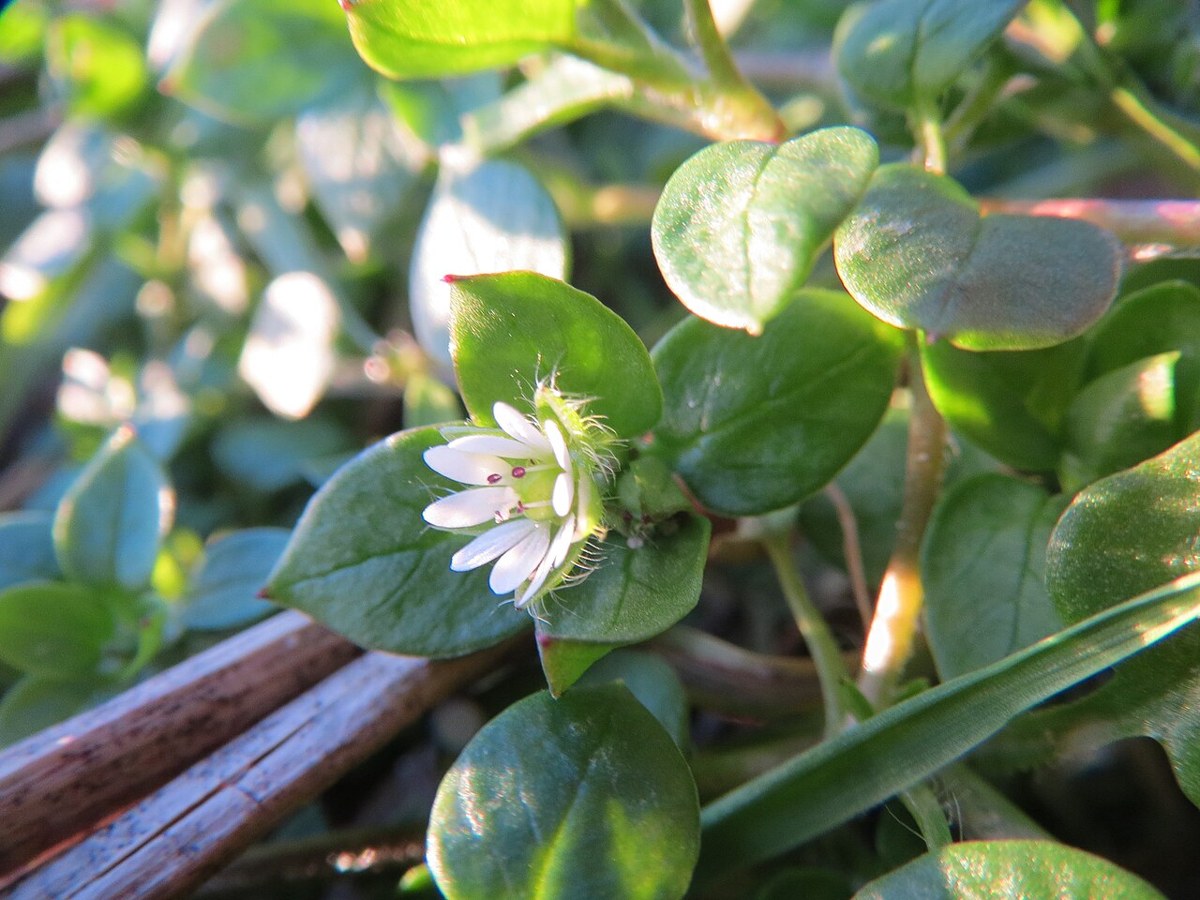
When beds and fields empty out in late autumn, a fresh green carpet often remains: common chickweed (Stellaria media). It is one of the few wild herbs that keeps growing and flowering in November and even in winter. It has a long tradition as a wild vegetable – but it has a poisonous lookalike that even shared one of its old German nicknames, "Hühnerdarm" ("chicken gut"). Here is how to tell the two apart.
Why chickweed is in season now
Chickweed is usually an annual, but it grows several generations a year. Plants that germinate in autumn overwinter and then live for about a year. Even in winter, new plants can grow from germinated seeds. In mild weather or sheltered spots it flowers all year round.
Its flat shoots, up to 40 centimetres long, cover the soil – protecting it from drying out in summer and from frost in winter. That makes it more useful in gardens and vineyards than its reputation as a "weed" suggests. The name says it: birds like to eat it.
How to identify chickweed
In common chickweed, these features go together:
- Habit: sprawling, with stems 3 to 40 centimetres long, often forming small mats.
- Stem: round in cross-section and usually hairy along a single line only. Dew drops run along this line of hairs to the next pair of leaves.
- Pull test: if you gently pull a stem apart, a white, stretchy inner strand stays behind. Hence German names like "chicken gut" and "mouse guts".
- Leaves: opposite, oval with a pointed tip. The lower ones have short stalks, the upper ones sit directly on the stem.
- Flowers: small and white, with five petals that are split almost to the base – so the flower looks as if it had ten. The anthers are purple, and there are three styles in the centre. Sometimes the petals are missing altogether.
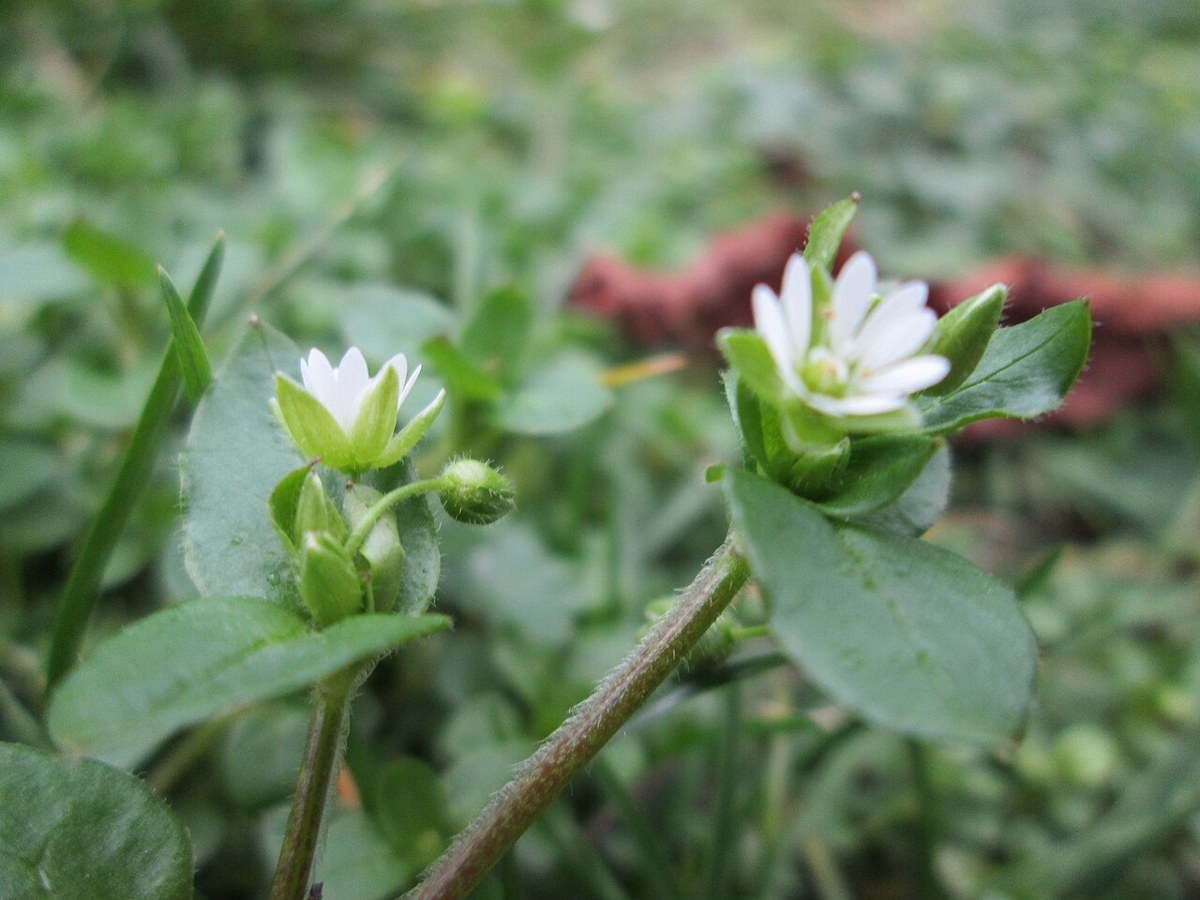
Common chickweed in late January: white star-like flowers and fine hairs on the stem. Photo: AnRo0002, CC0.

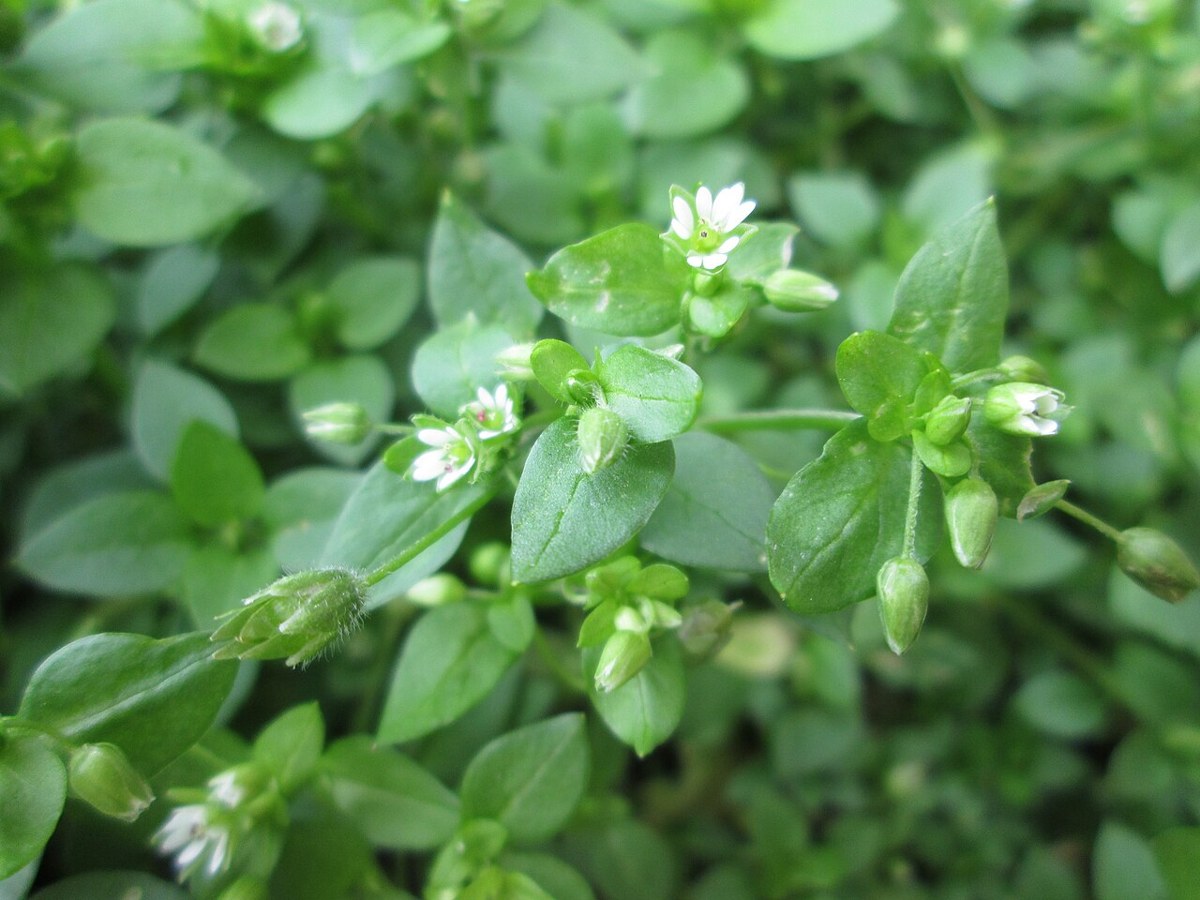
Chickweed in January: a dense, fresh green mat with a few flowers. Photo: AnRo0002, CC0.

Lookalike warning: scarlet pimpernel
Scarlet pimpernel (Anagallis arvensis, now also Lysimachia arvensis) grows in the same places: fields, gardens, vineyards and paths. It also creeps along the ground, has opposite, oval leaves – and in some regions of Germany it was also called "Hühnerdarm".
It is poisonous in all its parts, especially the root. Among other things it contains saponins and bitter compounds. In larger amounts it causes diarrhoea, nausea and vomiting. In sensitive people, even touching the leaves can trigger an allergic contact rash.
How to tell it apart:
- Stem: sharply four-angled – not round like chickweed.
- Leaves: opposite, oval, smooth-edged and all without stalks – they sit directly on the stem.
- Flowers: vermilion to orange, rarely blue, about 10 to 15 millimetres across, growing singly in the leaf axils. Five undivided petals, no white stars.
- Flowering time: May to October.
The late-autumn trap: after October, scarlet pimpernel usually stops flowering – and its most obvious feature is gone. So do not rely on the flower; rely on the stem and the pull test: round with a line of hairs and a white inner strand = chickweed. Four-angled = leave it.
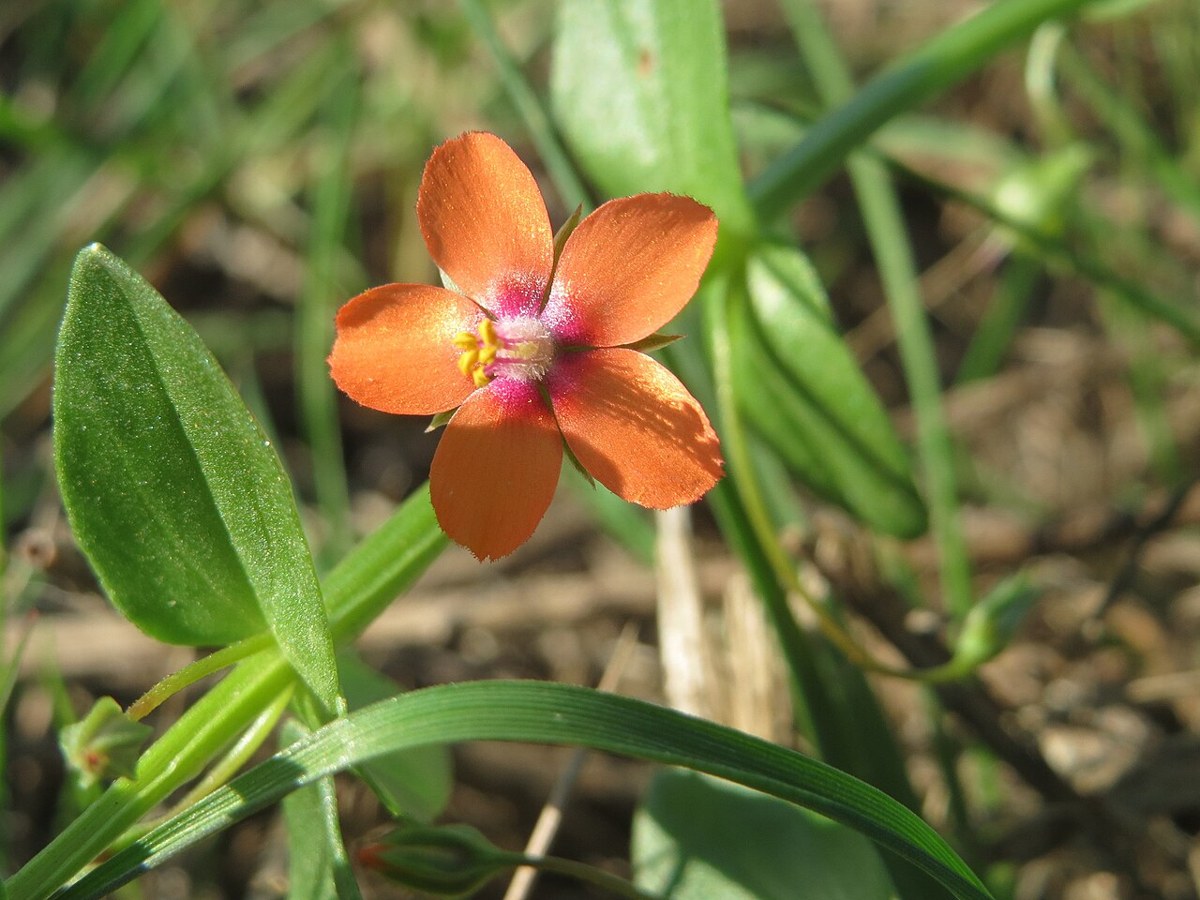
Scarlet pimpernel in mid-October: an orange-red flower, no white star flowers. Photo: AnRo0002, CC0.

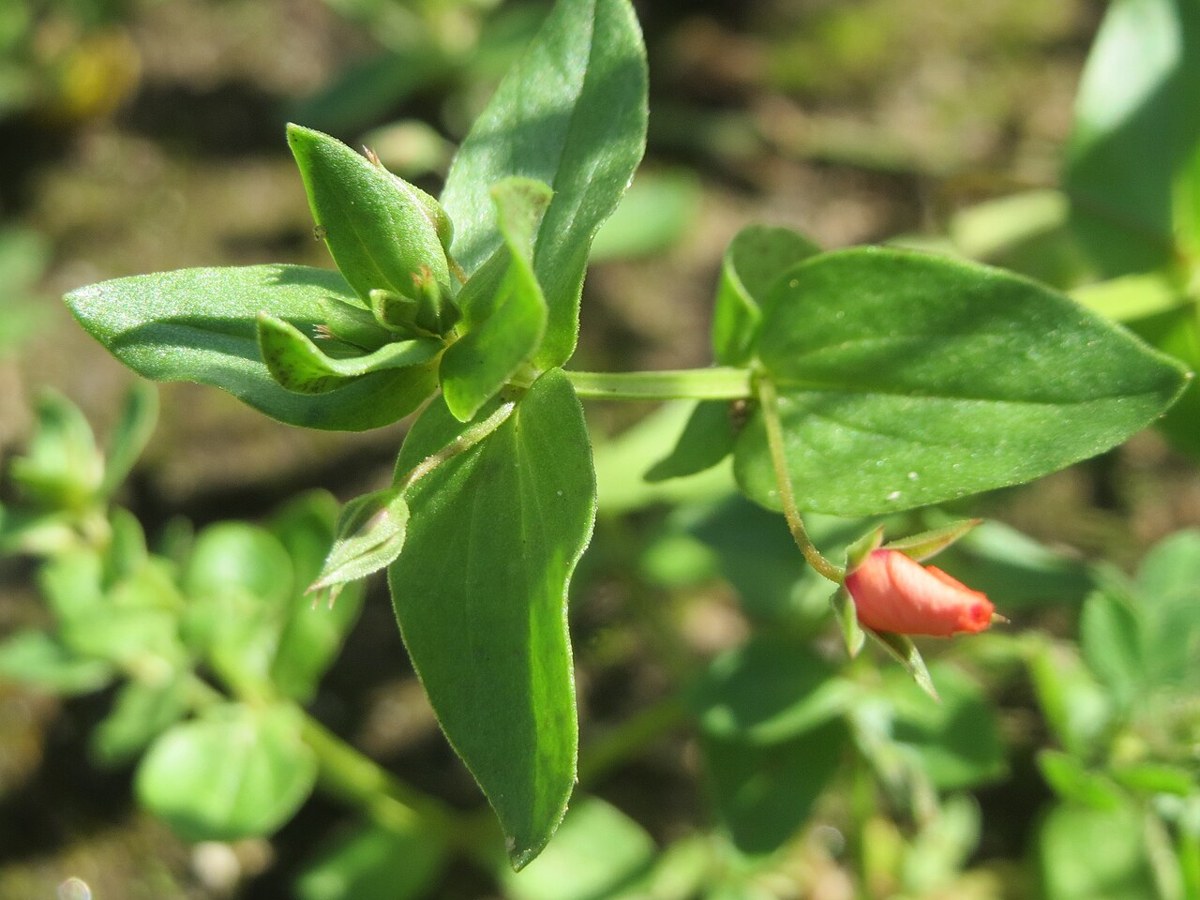
Scarlet pimpernel without an open flower: the leaves sit directly on the stem, without stalks. Photo: AnRo0002, CC0.

The one rule
A round stem with one line of hairs, a stretchy white inner strand, pointed leaves with stalks lower down, and small white flowers with deeply split petals: only gather when everything matches chickweed. If the stem is angular, the flower red or blue, or you are not completely clear – leave it. It is best to take only shoots you have looked at one by one, rather than pulling up whole clumps with other plants growing in them.
How chickweed is used
Chickweed is used as a wild vegetable, mostly raw. Its taste is often compared to young raw sweetcorn. It is typically added to salads. Among other things it contains vitamins and minerals, but also saponins – so it is more of an addition than a main ingredient.
Practical tips for gathering:
- Cut, do not pull: with scissors you take only the fresh upper shoot tips. The plant stays in the ground, and you get less soil and stray leaves in your basket.
- Choose clean spots: not right next to roads, not on dog-walking meadows and not on fields that may have been sprayed.
- Wash thoroughly and sort out soil, grasses and other leaves.
Chickweed is also given to pet birds and rodents as fresh food.
Chickweed in folk medicine
In folk medicine, chickweed was traditionally used for respiratory complaints, among other things. An old Latin name is Morsus gallinae – "hen's bite". This is cultural history, not a recommendation: it does not prove any effect. Scarlet pimpernel, which was also once considered a medicinal herb, is explicitly advised against because of its toxicity.
Where chickweed grows – and the rules for gathering
Chickweed has followed people since the Stone Age and is found worldwide today. It grows on moist, nutrient-rich soils: in gardens and beds, fields, vineyards, along paths, on waste ground and riverbanks, even in partial shade.
- Your own garden is the easiest place: it usually turns up there as a "weed" anyway.
- Other people's gardens and fields belong to someone. Ask first.
- Wild herbs: in Germany, Section 39(3) of the Federal Nature Conservation Act allows you to gather wild leaves and herbs in small quantities for personal use, with care – in places you are allowed to enter.
- Protected areas: special bans may apply in nature reserves. Look out for signs.
There is more to find outside in late autumn. Which berries are hanging on the shrubs right now is explained in Are barberries poisonous?
Quick checklist
- A sprawling herb with round stems and one line of hairs? → points to chickweed.
- Pull a stem apart: a white, stretchy inner strand? → matches.
- White flowers with five deeply split petals and purple anthers? → matches.
- Angular stem, stalkless leaves, red or blue flowers? → scarlet pimpernel, poisonous.
- Only take shoots you have looked at one by one; cut, do not pull.
- Only where you may: your own garden, with permission, or wild plants in small quantities.
Find chickweed near you
The Fruit Pin map shows freely accessible finds – fruit trees, nuts, berries and herbs. Set the filter to Herbs and In season to see what is growing near you right now.
A pin on the map does not replace identifying the plant on the spot: always look at the stem, leaves and flowers yourself.
Know a freely accessible spot with chickweed? Add it with Add Pin so others can find it too.
Before you pick
Identify every plant yourself with certainty before you eat it. Entries on this map come from users and are not verified by us. When in doubt, do not consume.