Foraging juniper berries – and how to spot savin
In autumn, ripe juniper berries hang on the bushes. How to recognise common juniper – and the poisonous savin juniper that looks much like it.
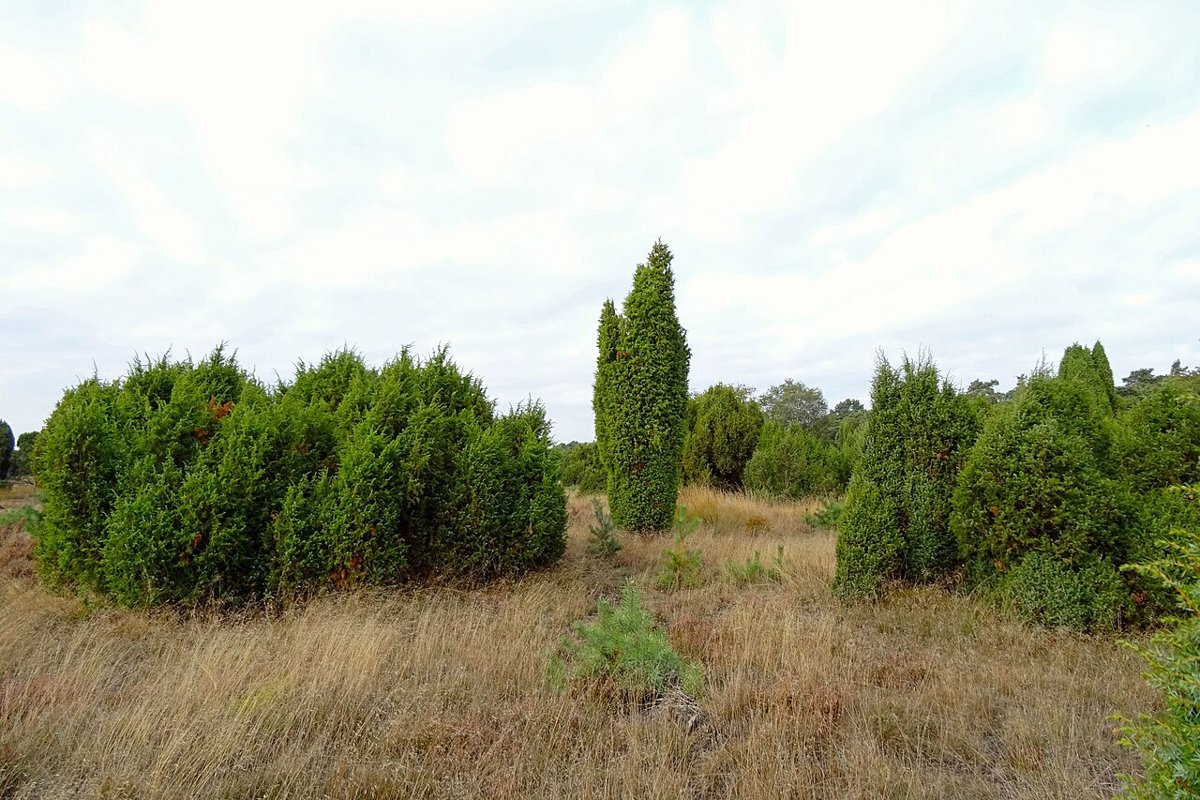
When sauerkraut is being made in autumn and game comes to the table, one spice is almost always involved: the juniper berry. It comes from common juniper (Juniperus communis), which grows on heaths, poor pastures and stony slopes. Here you will learn how to recognise it, why green and blue berries hang on the same bush – and why you need to know savin before you pick a single berry.
Common juniper
Juniper is an evergreen member of the cypress family. It grows as a shrub or small tree, often narrowly conical, sometimes almost like a column. Because grazing animals leave it alone, it shapes landscapes created by grazing – such as the Lüneburg Heath or the juniper heaths of the Swabian Jura in Germany. In 2002 it was Germany's Tree of the Year.
In German it has many old names: Machandel, Kranewitt, Reckholder. The juniper tree of the Brothers Grimm fairy tale "The Juniper Tree" is the Machandelbaum.
How to recognise common juniper
The needles
- Sharp and prickly, 1 to 2 centimetres long.
- They always grow in threes, in a whorl around the twig.
- A pale, waxy stripe runs along the upper side.
The berries
Botanically, juniper berries are not berries but small, fleshy cones. They are round and roughly the size of a pea. They take a long time to develop: in the first year they are green, and they only ripen in the second to third year – then they are blue-black with a bluish waxy bloom. That is why green and ripe berries often hang side by side on the same bush.
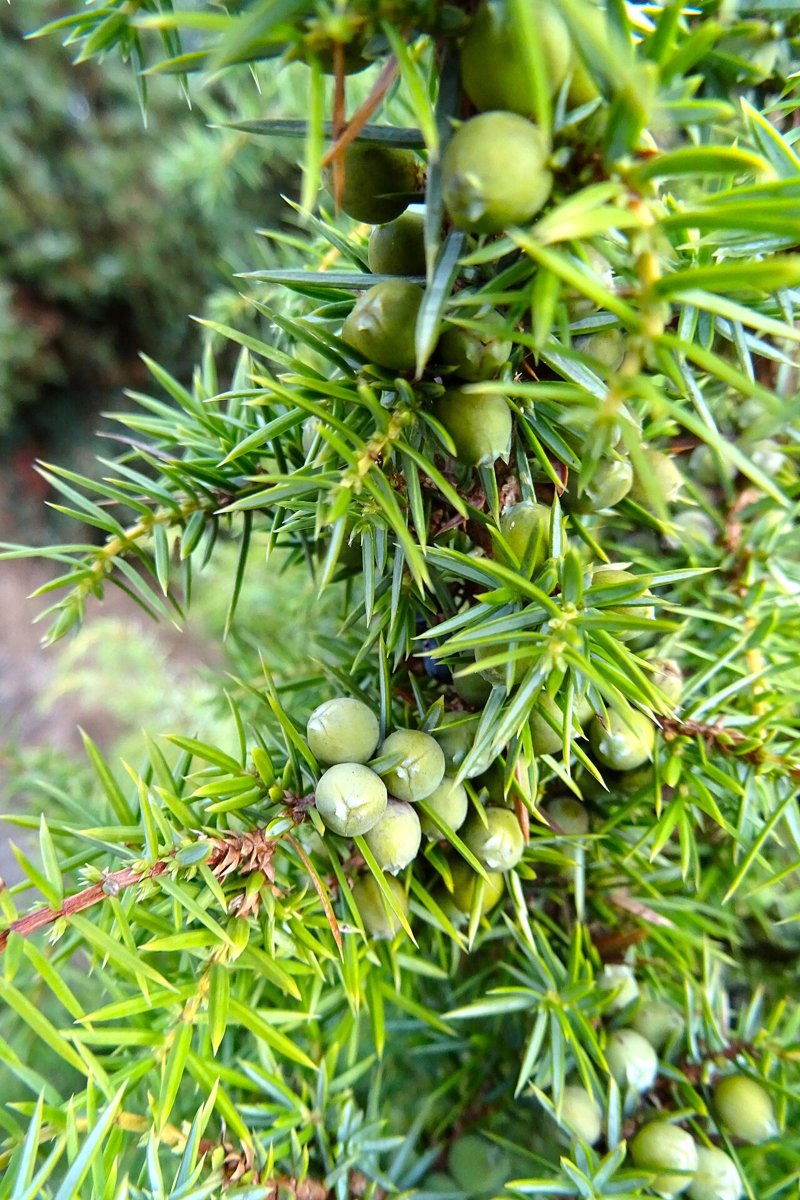
Common juniper: prickly needles in whorls, with green, unripe berries. Photo: Gouwenaar, CC0.

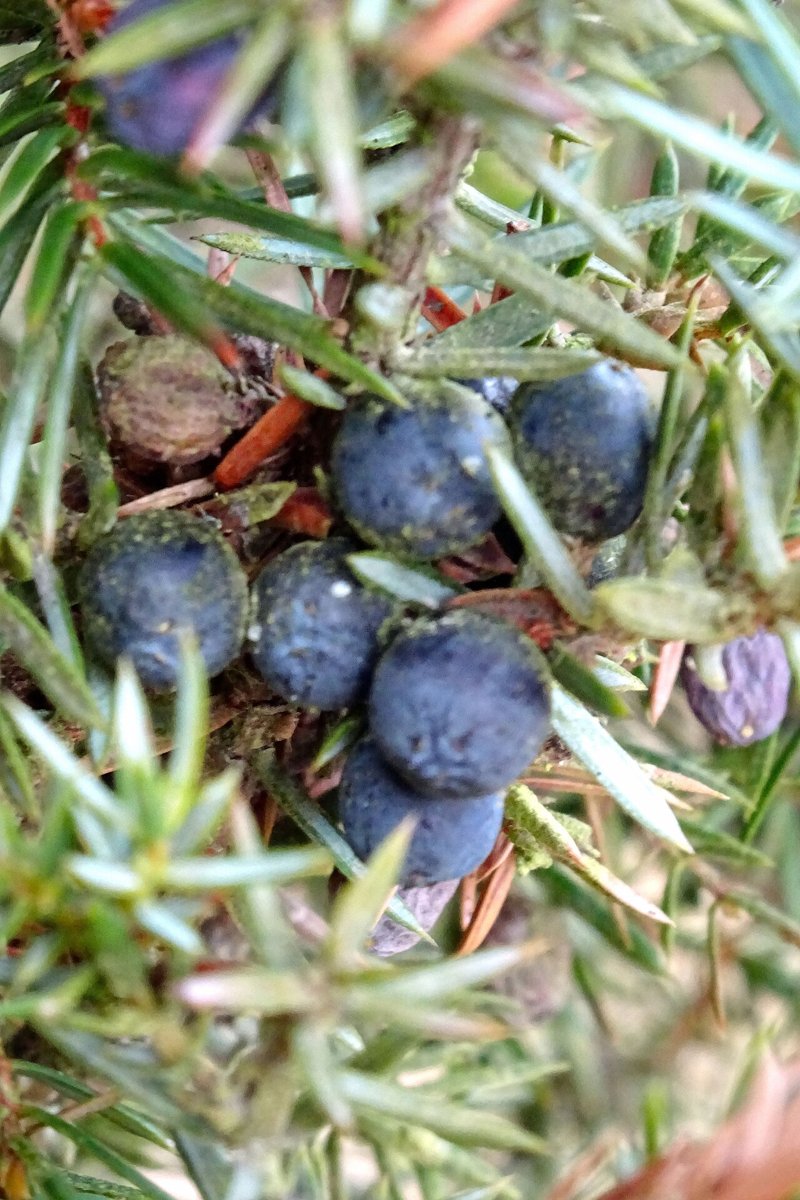
Ripe juniper berries in October: blue-black with a bluish waxy coating. Photo: Gouwenaar, CC0.

One more tip: juniper usually has separate male and female plants. Only female bushes carry berries. A juniper without berries is often simply a male bush.
Watch out: savin juniper
Savin (Juniperus sabina), also called stinking juniper, is a close relative. The Poison Information Centre in Bonn classifies it as poisonous – all parts of the plant, especially the shoot tips and berries. According to the centre, its essential oil causes severe irritation of the mucous membranes, heavy vomiting, cramps and kidney damage after ingestion, and in the worst case respiratory paralysis. On the skin it can cause strong irritation up to blistering, and it can be absorbed through the skin.
In Germany it grows wild only rarely, for example in the Bavarian Alps. According to the Poison Information Centre, however, it is widely planted as an ornamental shrub – in gardens, parks and public plantings. That is exactly where a mix-up is most likely.
How to tell it apart:
- Scales instead of needles: older savin plants carry small, scale-like leaves that overlap like roof tiles and sit in opposite pairs. The twigs look like those of a thuja. Young plants also have needles – but they are only 4 to 5 millimetres short.
- Growth: usually a low, creeping shrub with rising branches, rarely taller than 2 metres.
- Smell: the twigs smell unpleasant. Do not rub them between your fingers – the oil irritates the skin.
- Berries: small, hanging, egg-shaped, and when ripe also blue-black with a bloom. So you cannot tell the two apart by the berry alone.
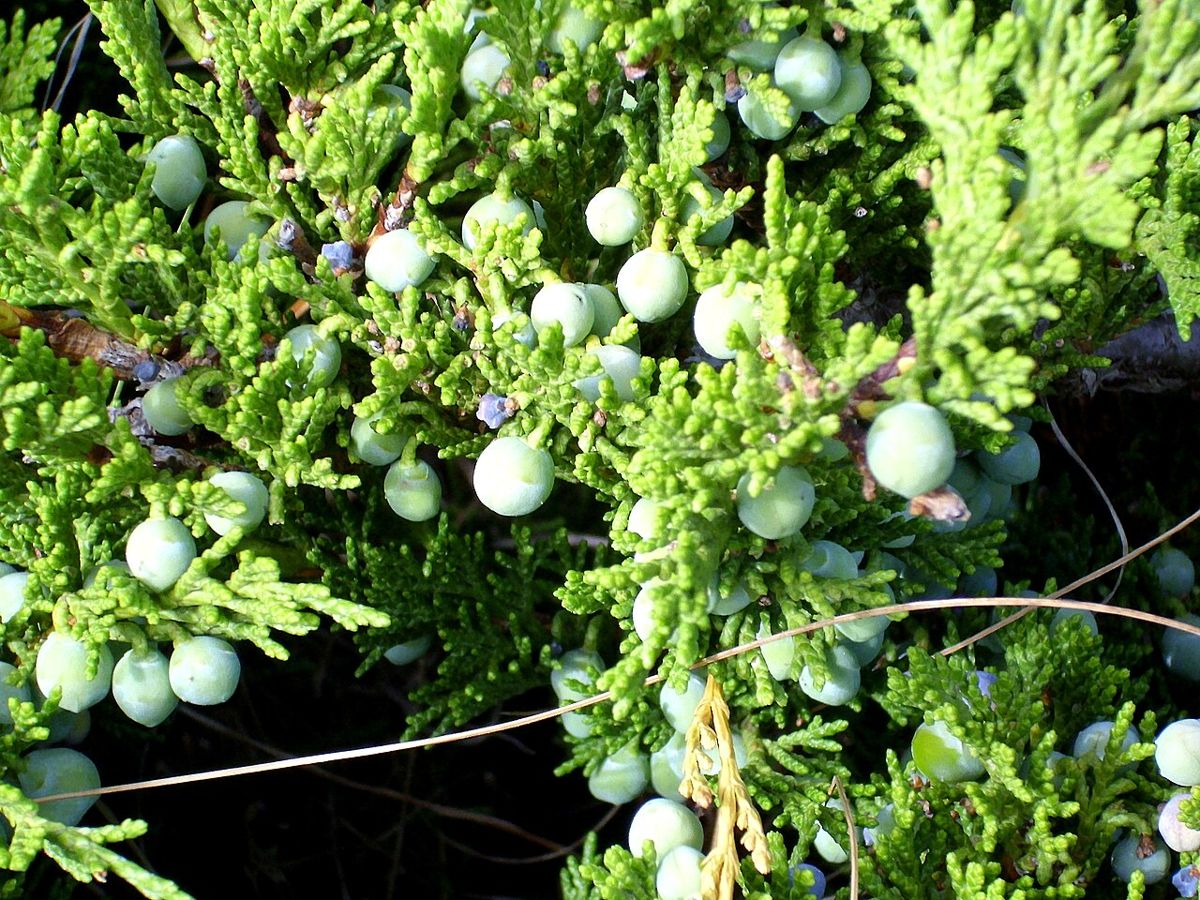
Savin: scale leaves instead of needles, with frosted berries. Photo: Javier martin, public domain.

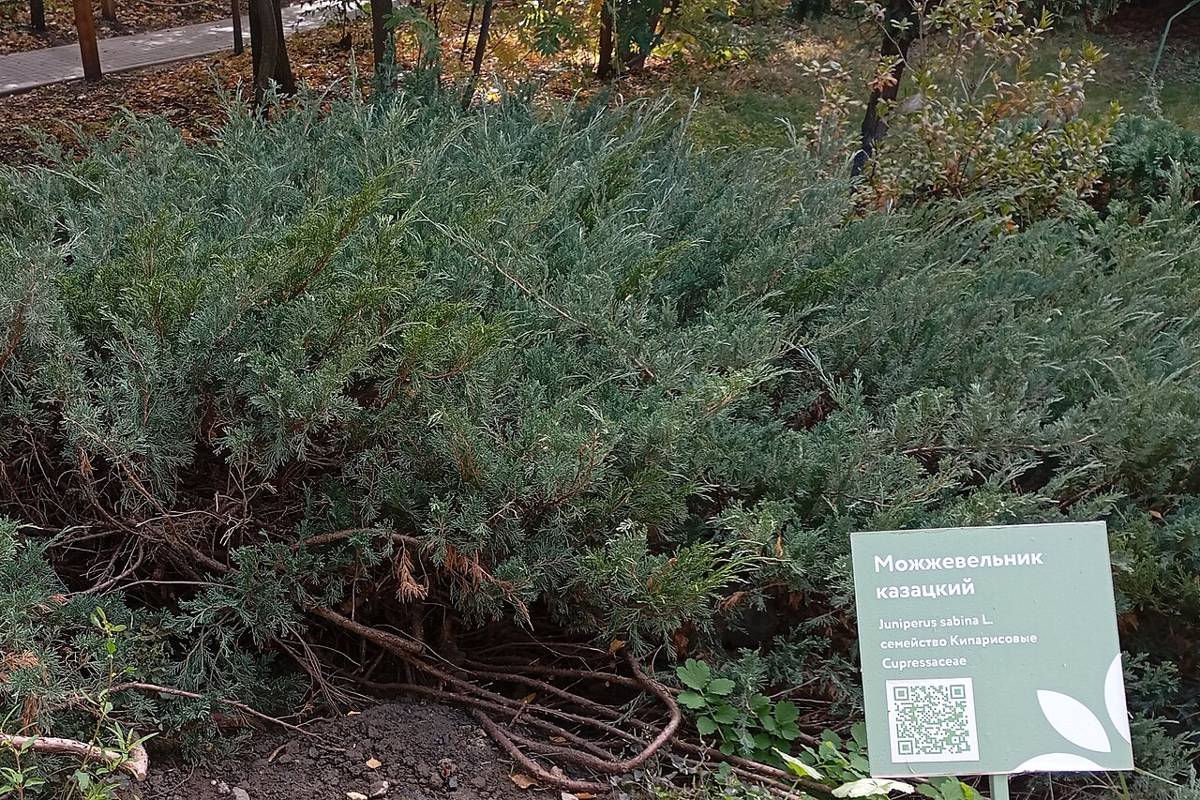
Savin as an ornamental shrub in a botanical garden: low and spreading. Photo: ИринаЯ, CC0.

History shows the mix-up is real: juniper berries contaminated with savin berries were repeatedly used in the past to flavour gin.
Thuja and other ornamental conifers
Thuja (arborvitae) also has scale leaves. It is planted as a hedge in many gardens and cemeteries, and the Poison Information Centre classifies it as poisonous. Its cones, however, are brown, scaly and upright – not berries. Gardens also hold many other juniper species and cultivars. So do not forage in gardens, parks or cemeteries.
Yew
Yew (Taxus baccata) is a conifer with flat, soft needles and a red seed cup that is open at the top. The Poison Information Centre classifies it as poisonous to highly poisonous. It is hard to confuse with blue-black juniper berries – do not pick anything from it.
The one rule
Prickly needles, 1 to 2 centimetres long, always in threes – and not a single scale anywhere on the bush: only then is it common juniper. If you see scale leaves or a low, creeping ornamental shrub, or if you have any doubt: leave it.
What the law says (Germany)
Common juniper is not on the list of specially protected plants in Germany's Federal Species Protection Ordinance. The Federal Nature Conservation Act, § 39 (3), allows you to gather wild fruit carefully in small quantities for personal use – in places you are allowed to enter.
- Juniper heaths are often protected areas. Juniper stands on calcareous heaths and grasslands are a habitat type of their own under the EU Habitats Directive. Nature reserves have their own bans – look out for signs and stay on the paths.
- Do not pick in other people's gardens or on private land.
- Take only the blue-black berries; the green ones need another one or two years. Ripe berries come off easily.
- Gloves help against the prickly needles.
- Leave some behind. Fieldfares, blackbirds and black grouse eat the berries and spread the seeds.
From bush to kitchen
Juniper berries are a spice, not a fruit. Dried, they season sauerkraut, sauerbraten and game dishes, go into curing mixes and add flavour when smoking. Crush them just before cooking. Too many taste soapy.
The Poison Information Centre in Bonn classifies common juniper as slightly poisonous as well: larger amounts of the berries can cause nausea, stomach pain and kidney irritation. Berries and juniper preparations are considered unsuitable during pregnancy. So juniper stays a spice – a few berries per dish, no more.
Juniper is in drinks, too: in the 17th century the physician Franciscus Sylvius mixed juniper berries with alcohol into a medicine called genever – which later developed into gin. German Steinhäger and Slovak borovička are flavoured with juniper as well.
Folk medicine and tradition
The Lorsch Pharmacopoeia from the end of the 8th century already lists juniper berries as a diuretic. In the Middle Ages they went into ointments for joint complaints. This is cultural history, not a recommendation – juniper is not for self-treatment, least of all with kidney disease.
At Christmas, juniper branches were hung over stable doors to keep witches away.
Quick checklist
- Prickly needles, 1 to 2 centimetres, always in threes? → Common juniper possible.
- Pale stripe on the upper side of the needles, green and blue-black berries on the same bush? → Common juniper.
- Any scale leaves, low creeping growth, unpleasant smell? → Possibly savin, do not touch.
- Gardens, parks, cemeteries? → Ornamental junipers and thuja grow there, do not forage.
- Only ripe, blue-black berries, only small amounts – and only where you are allowed to go.
- Juniper is a spice: a few berries per dish.
Find juniper near you
The Fruit Pin map shows freely accessible spots – fruit trees, nuts, berries and herbs. Set the filter to Berries and In season to see what may be ripe in your area right now.
A map entry does not replace identification on site: always check the needles, growth and berries yourself.
Know a juniper in a freely accessible place? Add a spot – so others can find it too.
For more wild fruit this autumn, see our overview Wild fruit in November.
Before you pick
Identify every plant yourself with certainty before you eat it. Entries on this map come from users and are not verified by us. When in doubt, do not consume.